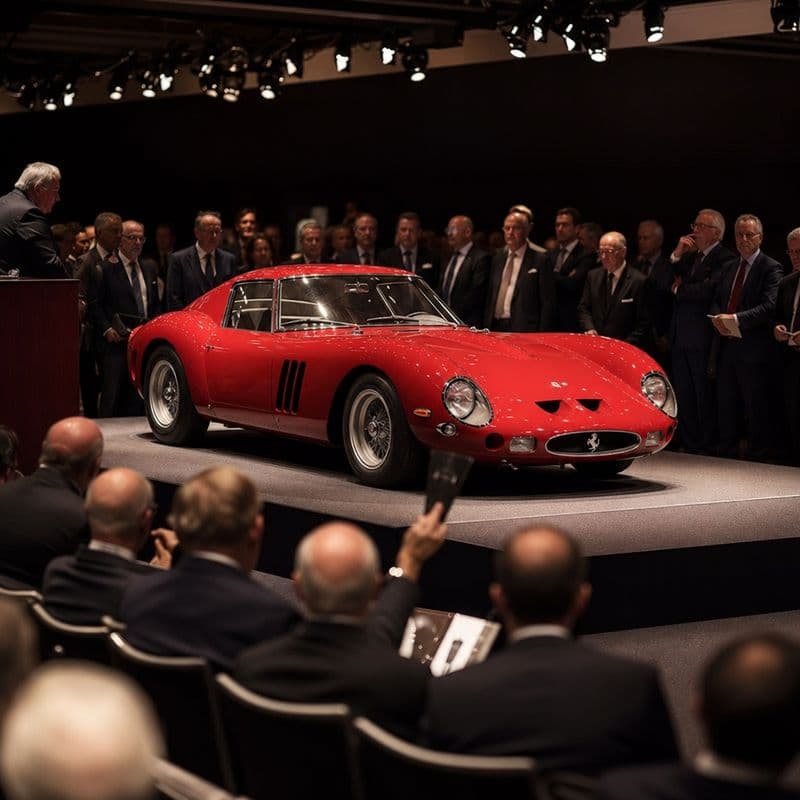
Your Car Can Outperform the S&P 500

Classic Cars vs the Stock Market — A Net-of-Costs Analysis
In October 2024, Hagerty published a chart that lit up every collector car circle and investment newsletter at once.
It showed the Hagerty Blue Chip Index — tracking 25 of the most sought-after postwar collector cars — outperforming the S&P 500 from 2007 through mid-2024.
For seventeen years, a basket of Aston Martin DB5s, Ferrari 250 California Spiders, and Lamborghini Miuras had beaten the stock market.
Then the lines crossed.
By spring 2024, the S&P had finally pulled ahead. Hagerty’s own headline read: “High-End Classic Cars Outperformed the Stock Market…Until Now.”
The article launched a thousand hot takes: The collector car market is finally correcting. Cars were always overpriced relative to equities. Cars are the last real store of value.
All three takes are wrong. The real story about classic cars vs the stock market is more interesting — and more useful — than any of them.
Classic Cars vs the Stock Market: The Context the Headline Misses
From 2007 through most of 2024, the Hagerty Blue Chip Index delivered higher cumulative returns than the S&P 500.
During the 2008 financial crisis, blue-chip collector cars drew down less than equities. Their recovery in the early 2010s was sharper. For over a decade, the line tilted in favor of the garage, not the brokerage account.
But that comparison carries an asterisk the size of a Bentley Blower.
The Hagerty Blue Chip Index tracks Condition 2 values: excellent, well-maintained examples of 25 specific postwar icons. It doesn’t account for storage, insurance, maintenance, or transaction fees. It doesn’t include the car that sat in a damp barn and lost half its value.
It measures the theoretical performance of a perfectly curated, zero-cost portfolio of the most desirable cars on Earth.
The S&P 500 total return index, by contrast, includes reinvested dividends and sits in a brokerage account for essentially zero cost. No climate-controlled garage. No concours-quality detail before each sale.
Comparing these two numbers without context is like quoting a fund’s gross return without mentioning the 2-and-20 fee structure. The headline looks great. The net is a different conversation.
Classic Car Returns vs. S&P 500: The Honest Numbers
With that caveat in mind, here’s what the actual data shows — a nuanced story neither the bulls nor the bears want to hear.
Hagerty Index Performance: Blue Chip vs. Broad Market
Hagerty publishes two major indexes that matter for this comparison.
The Blue Chip Index (25 postwar icons) outperformed the S&P 500 from 2007 through mid-2024 but has been essentially flat for four years.
The Hagerty Hundred (100 most commonly insured collectibles) peaked above $50,000 in May 2022 and has since dropped to around $43,000. Adjusted for inflation, it’s at an all-time low.
Two very different stories from the same asset class. The top 25 cars held value through a generational wealth cycle. The broader basket gave back its post-COVID gains and then some.

Individual Cars: Where the Alpha Lives
Indexes are useful, but nobody buys an index of collector cars. You buy one car. And at the individual level, the variance is enormous.
Autofolio analyzed seven collector cars against the S&P 500 from January 2015 to January 2025. Over that decade, the S&P returned 193%.
A 1997 Ferrari 355 appreciated roughly 300% — outperforming the index by 107 percentage points.
A BMW E30 M3, propelled by motorsport heritage and a cult following, narrowly edged out the S&P. A Porsche Carrera GT came in just shy of the benchmark — but still delivered a remarkable return for something you can drive to dinner.
At the higher end, the math gets even more interesting.
The Schumacher-driven Ferrari F2001 sold at RM Sotheby’s Monaco in May 2025 for approximately $18.2 million — more than double its $7.5 million result in 2017. That’s an annualized return north of 11% before costs.
The Porsche 964 generation has appreciated 69% over the past five years, with clean examples now approaching $150,000. Air-cooled 911s, Ferrari F40s, and the McLaren F1 have all ridden the same demographic wave into six- and seven-figure territory.
At those values, carrying costs shrink to a rounding error against the asset.
On the other side of the ledger: the Hagerty Market Rating dropped to 58.28 to start 2026, the lowest reading in 15 years.
Pandemic-era speculative favorites like the second-generation Dodge Viper have shed 8–10% as the post-COVID froth dissipates. Mass-market collectibles broadly have given back 15–30% from their 2022 peaks.
The pattern is consistent: cars with scarcity, provenance, or cultural resonance beat the market. Cars that rode a speculative wave are giving it back.
The Cost Drag Nobody Mentions
Here’s the uncomfortable part. Even when a collector car’s sticker value matches or beats the S&P, the net return almost never does.
Stocks sit in a brokerage account for free. A collector car has ongoing costs that compound against you every year.

On a $500,000 car, total carrying costs compress to roughly 0.5–1.4% of asset value — comparable to the expense ratio on an actively managed fund. At this level, a car appreciating at 5–8% annually clears the hurdle comfortably.
On a $100,000 car, those same fixed costs eat 2.5–7% of value annually. On a $50,000 car, the drag balloons to 5–14%. Your car needs to appreciate at double-digit rates just to break even against an index fund that charges 0.03%.
The lower the value, the harder the math.
Then there’s the tax penalty. The IRS classifies collector cars as collectibles, taxing long-term capital gains at a maximum federal rate of 28% — compared to 15–20% for equities.
A car that matches the S&P’s gross return over a decade underperforms after tax and carrying costs. The hurdle rate is higher than the headline numbers suggest.
A car posting a 10% annual gain on paper might net you 3–4% after storage, insurance, maintenance, and the collectibles tax rate. The S&P 500’s historical average of roughly 10% — especially in a tax-advantaged account — is a formidable benchmark to clear.
When Collector Cars Actually Beat the Stock Market
So if the cost drag is real and the tax treatment is worse, why do informed investors still allocate to collector cars?
Because there are scenarios where the math works — and a few where it works spectacularly.
The Right Car at the Right Time
Generational demand shifts create predictable waves. When a cohort reaches peak earning years, they buy the cars of their adolescence.
Gen X and millennial collectors have driven ’80s and ’90s performance cars into a different stratosphere. Hagerty’s segment indexes tell the story: the Japanese Car Index, the Supercar Index, and the RADindex (’80s and ’90s collectibles) have each gained 42–73% over the past five years — while 1950s American classics have declined.
At the entry level, the classic car appreciation rate has been striking.
A sixth-generation Honda Civic Si saw its average Condition 2 value climb from $15,500 in 2016 to $33,400 today — a 115% gain in a decade. The Corvette C6 Z06 has risen from $41,900 to $55,100 in five years, a 32% move.
These aren’t Ferraris. They’re attainable cars riding a demographic wave.
That same wave is now reaching into six- and seven-figure territory. Air-cooled Porsche 911s, Ferrari F40s, and the McLaren F1 are all benefiting from Gen X and millennial buyers entering peak collecting years with peak capital.
At those values, the carrying cost math flips decisively in the car’s favor.
Crisis-Period Resilience
During the 2008 financial crisis, the Hagerty Blue Chip Index drew down less than the S&P 500. The Knight Frank Luxury Investment Index tells the same story: the luxury sector weathered the global financial crisis better than financial investments.
Tangible assets with emotional attachment don’t get margin-called.
This doesn’t mean collector cars are immune to downturns — the Hagerty Hundred fell after 2022.
But the highest-quality segment has historically shown lower peak-to-trough volatility than equities during systemic crises. Collector car values have also demonstrated low correlation to public equities over most measured periods.
For investors weighing alternative investments vs. stocks — and building a portfolio that behaves differently under stress — that’s a meaningful diversification benefit.
The Utility Premium
No one takes their S&P 500 position to a concours d’elegance. No one drives their index fund through Malibu Canyon on a Sunday morning.
Collector cars offer what finance professors call “utility value” — the psychic and experiential return of ownership. That emotional utility sustains demand even when financial returns soften, creating a pricing floor that purely financial assets don’t enjoy.
When Stocks Win
Intellectual honesty requires stating the obvious: for most investors weighing alternative investments vs. stocks, equities remain the more efficient wealth-building tool. The advantages are structural.
Liquidity and transaction costs. You can sell an S&P 500 position in seconds for $0 commission. Selling a collector car takes weeks or months, and auction houses charge 10–15% buyer’s premiums plus consignment fees.
Even Bring a Trailer’s lighter model ($99 to list, 5% buyer’s premium capped at $5,000) means losing a meaningful slice on every round trip. Time your sale during Monterey Car Week and you might get a premium. List in January and crickets.
Compounding and diversification. Stocks pay dividends that get reinvested. Over decades, compounding is the most powerful force in investing. A collector car’s return is pure price appreciation — no yield, no coupon, no cash flow.
You can own the entire stock market for 0.03% annually. Diversifying in collector cars traditionally meant buying multiple vehicles, each with its own storage, insurance, and maintenance overhead. Emerging pooled investment structures are beginning to address that capital barrier — but access remains more limited than opening a brokerage account.
The Right Way to Think About Collector Car Investment in 2026
The question isn’t whether your car can outperform the S&P 500. Some cars have, dramatically, over meaningful time periods.
The question is whether your car will — after accounting for every dollar it costs you to own it.
The honest framework looks like this:

The sensible approach isn’t “cars instead of stocks.” It’s “cars alongside stocks” — a satellite
allocation within a diversified portfolio that includes traditional and alternative investments,
bought with domain expertise, held for the long term, and enjoyed along the way.
The driving experience isn’t a bonus. It’s part of the return.
The collector car market rewards expertise and selectivity, not passive allocation. If you have the
knowledge to source the right car — or access to managers who do — the patience to hold
through cycles, and a high enough value that carrying costs stay proportional, the math can
work.
For everyone else, the S&P 500 remains the most efficient wealth-building vehicle ever
invented. It just doesn’t sound as good at 8,000 RPM.
Frequently Asked Questions
Q: Have classic cars beaten the stock market?
Yes. The Hagerty Blue Chip Index outperformed the S&P 500 from 2007 through mid-2024. However, the S&P has since pulled ahead, and those classic car returns vs. S&P 500 comparisons don’t account for storage, insurance, maintenance, or transaction costs. Net of ownership costs, the gap narrows or reverses for most vehicles.
Q: Which classic cars have appreciated the most?
Over the past decade (2015–2025), Autofolio found that a 1997 Ferrari 355 appreciated ~300% vs. 193% for the S&P 500. The BMW E30 M3 and Porsche Carrera GT also delivered strong returns. More recently, Japanese performance cars (NSX, Supra, Skyline GT-R) and ’80s/’90s collectibles tracked by Hagerty’s RADindex have gained 42–73% over five years.
Q: What are the hidden costs of investing in collector cars?
Climate-controlled storage ($1,800–$4,800/year), collector insurance ($284+ average), maintenance ($500–$2,000+/year), and auction fees (10–15% buyer’s premium at major houses). On a $100,000 car, total carrying costs run 2.5–7% of value annually. The IRS also taxes collector car gains at up to 28% — versus 15–20% for stocks.
Q: Is 2026 a good time for collector car investment?
The market is bifurcated. The Hagerty Market Rating hit a 15-year low of 58.28 in early 2026, and mass-market collectibles remain soft. But Q1 2026 dollar volume is up 31% year-over-year, and seven-figure sales are at record levels. For selective buyers with expertise, the correction in mid-tier cars may represent opportunity. For passive investors, the S&P 500 remains more efficient.
Q: Can I invest in collector cars without buying a whole car?
Yes. A growing number of platforms now offer fractional or pooled access to investment-grade collector cars through structures like SPVs (special purpose vehicles) and dedicated funds. These allow accredited investors to gain exposure to curated vehicles with professional acquisition, storage, and exit management — without the operational burden of individual ownership. Minimums, structures, and liquidity terms vary by platform.

Joseph Chappius — Automotive Journalist
Fifteen years in wealth management. Now writing about collector cars, alternative assets, and the stories behind them. All articles →