


Why Classic Cars Are Becoming a Serious Alternative Asset in 2026

For most of the last fifty years, "investing in classic cars" was a phrase used by hobbyists trying to justify the next purchase to a spouse. The cars compounded, but no allocator looked at them the way they looked at private credit, real estate, or even fine art.
That has changed quietly, and then all at once.
In 2025, global collector car auction and online sales reached approximately $4.8 billion, up roughly 10% year over year. RM Sotheby's alone crossed $1 billion in total sales for the first time (RM Sotheby's year- end results). Knight Frank's Luxury Investment Index now treats classic cars as a standalone asset class alongside art, watches, and rare whisky. Hagerty has been a publicly traded company since December 2021. CLASSIC.COM publishes monthly market reports and an open-access database of auction comparables.
The shift isn't that cars suddenly became valuable. It's that the infrastructure around them now looks the way the infrastructure around private equity looked in the late 1990s: investable, indexed, and increasingly intermediated. In 2026, the case for treating collector cars as a serious alternative asset isn't a stretch. The case for ignoring them is.
What Counts as an Alternative Investment in 2026?
Anything outside the public-equity and bond stack that generates returns on a different schedule. The 2026 bucket includes private credit, infrastructure, venture, real estate, royalties, art, wine, watches, farmland — and now, formally, classic cars.
The term has drifted. A decade ago, "alternatives" mostly meant hedge funds and private equity. Today, the bucket includes private credit, infrastructure, venture capital, real estate, royalties, art, wine, watches, farmland, and now cars. The unifying thread is structural, not stylistic: alternative assets generate returns that don't move in lockstep with public equities and bonds, and they typically come with more friction, higher minimums, and longer holding periods.
That definition has always fit collector cars. What's new is that the rest of the package, the data, the access vehicles, and the institutional respect, has finally caught up with the underlying economics.
What Pushed Classic Cars Into the Alternatives Conversation?
Five structural shifts: real-time data transparency, a defined investment-grade tier, SPV-based access, a quantified generational wealth transfer, and a macro environment that rewarded real assets. None of them existed at scale a decade ago
1. Data Transparency Became Real
Ten years ago, if you wanted to know what a 1973 Porsche 911 Carrera RS was worth, you called three dealers and averaged the lies. Today, Hagerty publishes Condition 1 through 4 values updated quarterly, the Hagerty Market Rating publishes monthly, and CLASSIC.COM aggregates auction comps across Bring a Trailer, RM Sotheby's, Gooding, Bonhams, and dozens of regional houses. Bring a Trailer's annual dollar volume grew roughly fivefold between 2019 and 2022 (approximately $280M to ~$1.36B), per BaT's year-end recaps and Hagerty Insider's BaT volume analyses.
Allocators don't allocate to opaque markets. They allocate to markets where they can mark a position. That now exists for collector cars in a way it didn't a decade ago.
2. The Bifurcation Created a Real Investment-Grade Tier
Hagerty's 2026 framing is precise: "a strong top end, but a soft underbelly." The Hagerty Market Rating, at 59.01 in April 2026, sits in flat-market territory and well below its 2022 peak, and mass-market collectibles have given back 15 to 30% from their pandemic peaks. Meanwhile, the top of the market is breaking records. RM Sotheby's posted its best year ever in 2025, with bidders from 82 countries and 46% of bidders participating for the first time (RM Sotheby's year-end results).
For an investor, that bifurcation is actually useful. It separates the cars that behave like financial assets from the cars that behave like used car classifieds. The investment thesis can now point to a defined segment, not the whole market, and that's how every other alternative asset class operates.
3. Fractional and SPV Structures Solved the Access Problem
The historical wall around collector car investing wasn't analytical. It was operational. A serious car required a wire, a transport carrier, a storage facility, a specialist insurance broker, and a buyer when it was time to exit. In 2026, fractional platforms and single-asset SPVs handle all of that. Accredited investors can take a position in a $5 million Ferrari the same way they take a position in a private credit fund: a subscription document, a capital call, and an annual report.
The Masterworks parallel is direct. Art was an inaccessible asset class until structured vehicles made it allocatable. Collector cars are following the same path five years behind.
4. The Generational Wealth Wave Has Been Quantified
Cerulli Associates projects $124 trillion in wealth transfers across generations through 2048. Millennials are projected to inherit the largest share over the full window (roughly $46 trillion), with Gen X receiving the most in the next decade ($14 trillion vs. $8 trillion to millennials). The buyer mix has not flipped yet: Hagerty's 2025 data shows Boomers reclaimed the top share of collector car activity at roughly 36% of quotes, with Gen X near 34% and Millennials slipping from 21% to under 19% as homeownership and cost-of-living pressures bite. But the forward catalyst is the wealth transfer, not today's mix, and the demand signal is already visible in the cars younger buyers favor: Hagerty's Japanese Car Index, Supercar Index, and RADindex (covering 1980s and 1990s collectibles) have posted five-year gains of 42 to 73%.
This is not nostalgia. It is a measurable demand shift, and it is the cleanest demographic tailwind in the alternative asset universe right now. Few other alts have a $124 trillion wealth handoff with a documented preference shift behind them.
5. The Macro Pushed Capital Toward Real Assets
The 2022 to 2024 inflation shock and the bond market drawdown that came with it forced allocators to rethink the 60/40. Real assets, the broad bucket that includes commodities, real estate, infrastructure, and collectibles, attracted serious institutional flows. Cars rode that wave alongside everything else. They're not the marquee real-asset trade, but they're now in the conversation, and the data infrastructure to evaluate them is finally there.
How Do Classic Cars Compare to Other Alternatives?
Classic cars sit between fine art and rare whisky on long-run return. They trail public equities over a decade and aren't supposed to catch them. The case is diversification and non- correlation, not raw return.
Cars don't replace any of the standard alternatives. They occupy a specific seat at the table.
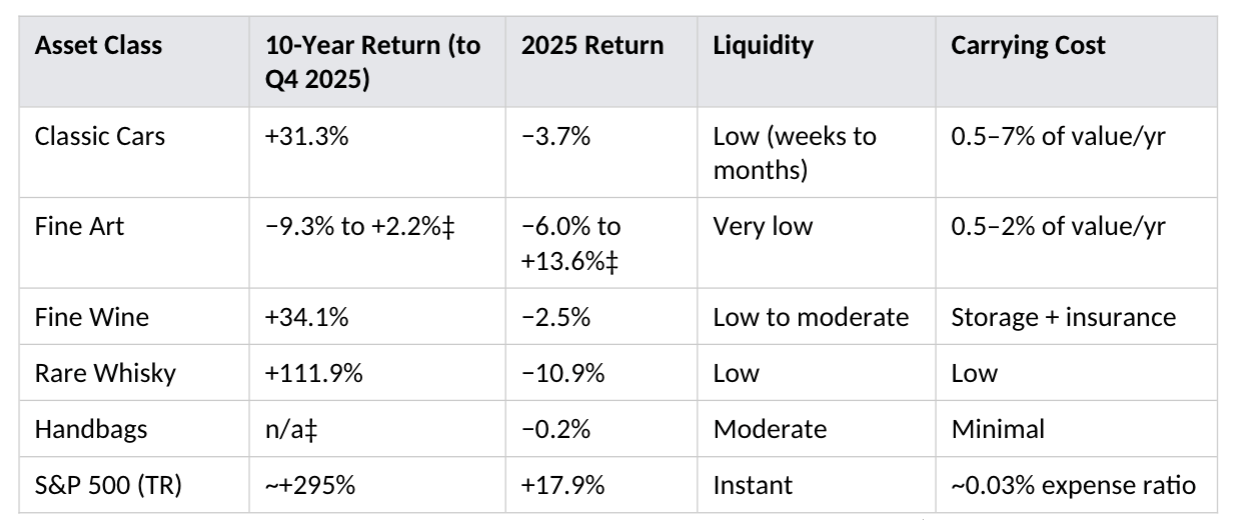
Sources: Knight Frank Luxury Investment Index, 2026 Wealth Report Databank (returns to Q4 2025; KFLII overall −0.4% for 2025 and +38.6% over ten years). S&P 500 total return per S&P Dow Jones Indices (+17.9% in 2025; ~+295% cumulative 2016–2025 with dividends reinvested). KFLII rows use the matching Databank line: cars (KFLII "Cars" index, −3.7% / +31.3%, mirroring the HAGI Top 50), fine wine (Liv-ex 100, −2.5% / +34.1%), rare whisky (−10.9% / +111.9%), handbags (Hermès Birkin index, −0.2%; the Birkin index has no 5- or 10-year history in KFLII). ‡For 2025 Knight Frank replaced the single art index with six sub-indices; the ranges show the spread across Impressionist (+13.6% in 2025 / −0.0% over 10 years), modern (+7.1% / −9.3%), post-war (+5.2% / −0.2%), top-100 artists (+3.6% / −8.1%), European Old Masters (+1.7% / +2.2%) and contemporary (−6.0% / −0.3%). There is no longer a single KFLII "art" composite.
Two takeaways. First, no single luxury collectible leads every year: 2025 was an Impressionist-led art recovery (Impressionist +13.6%, even as contemporary fell 6.0%) in which classic cars gave back 3.7% while the broader Knight Frank index essentially flatlined at −0.4%, close to the mirror image of 2024, when cars were among the few categories in the green and art fell hard. That rotation is the point. These categories do not move together, and art itself no longer moves as one thing. Second, cars will not catch the S&P over a decade in raw return terms, and they're not supposed to. The case for cars is that they compound on a different schedule and respond to different inputs, which is the textbook definition of a portfolio diversification benefit.
Who this is for: accredited investors and allocators weighing a small, multi-year satellite position in tangible alternatives, not enthusiasts looking to justify a weekend purchase.
What Are the Honest Caveats?
Three: carrying costs that punish anything below six figures, a 28% federal collectibles tax rate on long-term gains, and market opacity that still trails public-market disclosure standards.
Three things will keep collector cars from ever fully resembling a public-market allocation.
Carrying costs are real. Storage, insurance, and maintenance run roughly 0.5 to 1.4% of value per year on a $500,000 car and 2.5% to over 7% on a $100,000 car. Anything below the six-figure mark is rarely an investment. That is a hard math reality, not an opinion.
Tax treatment is worse. The IRS classifies collector cars as collectibles. Long-term gains are taxed at a maximum federal rate of 28% versus 15 to 20% for equities. Any net-of-tax comparison has to start there.
The market is still opaque relative to public markets. No SEC equivalent. No standardized reporting. Private sales invisible to indexes. The data has improved enormously. It is not yet the level of disclosure an institutional allocator would call clean.
These caveats don't disqualify the asset class. They define the appropriate allocation size: a 5 to 15% satellite to non-correlated alternatives, sized for a multi-year hold, with no expectation of interim cash flow.
The Bottom Line
Collector cars in 2026 sit roughly where art sat around 2018: legitimate, indexed, increasingly intermediated, and still misunderstood by the average allocator. The math on costs and taxes is unforgiving at the bottom of the market and reasonable at the top. The data infrastructure is no longer the bottleneck. Access vehicles that didn't exist five years ago now do.
That doesn't make every car an investment. It makes the asset class itself one that an allocator can actually consider with a straight face. Whether to allocate is a portfolio question. Whether the asset class deserves the conversation is no longer in doubt.
Frequently Asked Questions
Q: Are classic cars officially recognized as an alternative asset?
There is no formal designation, but the practical answer is yes. Knight Frank's Luxury Investment Index treats classic cars as a standalone tracked category. Wealth managers increasingly cover them under the alternatives umbrella alongside art, wine, and watches. The 2025 auction market reached approximately $4.8 billion globally, large enough for major advisers to track it alongside other tangible alternatives.
Q: How big is the global collector car market?
Hagerty estimates total auction and online sales reached roughly $4.8 billion in 2025, with online classic- car sales alone surging 12% to $2.5 billion. RM Sotheby's crossed $1 billion in sales in 2025 for the first time. The collector car auction market is smaller than fine art auctions (Sotheby's alone reported approximately $7 billion in 2025) but is now in the same order of magnitude, and total assets in private collections are far larger and largely untracked.
Q: What return have classic cars delivered as an asset class?
Per the 2026 Knight Frank Wealth Report, the KFLII "Cars" index returned about 31% over the ten years to Q4 2025, roughly 2.8% annualized, and the broader Luxury Investment Index returned about 39% over the same decade. Both trail the S&P 500 by a wide margin over that window (the index returned roughly 295% with dividends reinvested). That gap is the point: collector cars are a diversification and non-correlation allocation, not a raw-return substitute for equities.
Q: Can institutions actually invest in collector cars now?
Yes, through structured vehicles. Single-asset SPVs and fractional platforms allow accredited investors to take positions in specific cars without the operational burden of direct ownership. These structures handle custody, insurance, maintenance, and exit, and they've matured significantly since 2020. Minimums and structures vary by platform.
Q: What's the right allocation size for collector cars in a portfolio?
Most advisors who include tangible assets suggest a 5 to 15% satellite allocation to non-correlated alternatives, with collector cars sitting inside that bucket alongside art, wine, and other real assets. Direct ownership requires significantly higher commitment given carrying costs scale poorly below the $250,000 mark.
Q: What separates investment-grade collector cars from the rest of the market?
Three filters: verifiable scarcity (production numbers, surviving examples), airtight provenance (matching numbers, ownership history, competition records), and broad international demand. Cars that meet all three behave like financial assets. Cars that miss any of the three behave like used cars in a softening market.
Q: Is now a good time to allocate to collector cars?
The market is bifurcated. Top-tier cars are at or near record prices; mass-market collectibles are 15 to 30% below pandemic peaks. The Hagerty Market Rating, at 59.01 in April 2026, remains in flat-market territory and well below its 2022 peak, a soft broad-market reading that historically has been a buyer's signal at the middle and upper-middle tiers. Allocators with a long horizon and selective sourcing have the cleanest setup the asset class has offered in years.
Related Update