Ferrari F40 Investment Guide: Why It Became an Icon
Key takeaways:
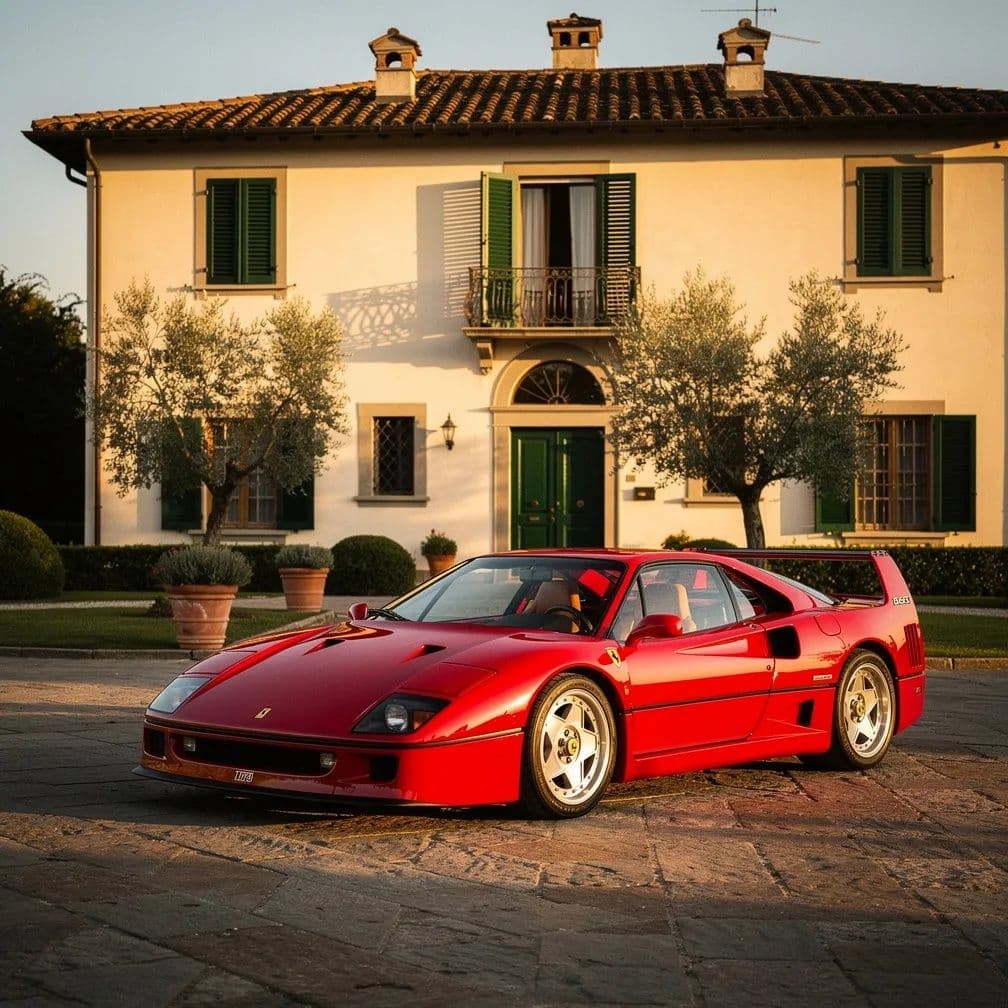
- The F40 was Ferrari’s 40th-anniversary car and the last personally approved by the company’s founder, Enzo
- Ferrari’s stripped-down F40 diverged from late 1980s’ flamboyant, tech-heavy supercar design, making it an analog icon
- The F40 was the first street-legal production car to break 200 mph speed barrier
- Key Ferrari F40 market trends include the average production year of a collectible auctioned in 2026 being 1989, aligning with this model’s early production, according to Hagerty data.
The Ferrari F40’s Origin Story And Why It Mattered
Story and historical significance form the basis of why a Ferrari F40 investment is at the forefront of many collectors’ minds. The Ferrari F40’s status as the automaker’s 40th anniversary car and the last model personally approved by the company’s founder, Enzo Ferrari, before his passing, solidified its status as a high-value collectible from the start. As years went by and electronic aids became the norm, Ferrari F40 market trends benefited from the model being the company’s final raw, analog example, as descriptions like “last of an era” emerged.
Produced from 1987 to 1992 (standard version), the F40 was Ferrari’s direct response to the late 1980s supercar arms race, in which economic optimism, celebrity culture, and motorsport homologation rules led manufacturers to produce the most technologically advanced and highest-horsepower road cars. The F40 distinguished itself during this period against flamboyant rivals like the Lamborghini Countach with a more minimalist approach, stripping away unnecessary elements and amplifying its essential components for a rawer experience. The Italian automaker initially planned to manufacture 400 F40 units, but demand shock increased this number to 1,315 examples. In turn, the F40 became a cultural symbol, embodying Ferrari’s core values of speed, innovation, and sheer passion, enhancing its collector value.
What Made The Ferrari F40 Different From Other Supercars Of Its Era
The F40’s position as a minimalist supercar stemmed from intentional choices including, but not limited to, lightweight engineering inspired by its racing heritage, forced induction drastically increasing power, and a unique body design creating purposeful aerodynamics
Lightweight Engineering And Race-Car Philosophy
The Ferrari F40’s material and design choices evolved from a distinct motorsport development path. In the mid-1980s, Group B rally cars were too fast for the time, and their lack of driver and fan safety led to the sport’s cancellation following the 1986 season. Ferrari had developed the 288 GTO partly for the FIA’s Group B racing, but the series’ cancellation left the automaker with highly developed prototypes lacking a program. These prototypes influenced the F40’s engineering foundation and overall development, particularly its focus on weight reduction and structural simplicity. Enzo Ferrari stated that he wanted a car that reminded the company of Le Mans and the 288 GTO.
Part of the F40’s collector appeal is that its exterior looks modern decades later. This Ferrari features lightweight carbon fiber doors, bonnet, and trunklid, helping it achieve a groundbreaking dry weight of 1,100 kg (about 2,425 lbs). The F40 was also among the world’s first production road cars with a body made almost exclusively of composites (Kevlar and carbon fiber), contributing to its exceptionally low weight. These characteristics resulted in a high level of mechanical purity that’s increasingly scarce today, strengthening the F40’s long-term collector appeal alongside its association as a poster car.
Performance That Shocked The World In 1987
Ferrari’s F40 wasn’t just the lightest flagship supercar at the time of its release; it was also the first production road car to exceed 200 mph. The F40 maintained its status as the fastest production road car from 1987 to 1989 with a top speed of 201 mph. The media’s astounded reaction helped build a narrative shaping collectibility, with a reputation that compounds over decades. However, the F40’s speed isn’t the only performance factor influencing its long-term collector demand. The 2.9-liter twin-turbo V8 engine sent its aggressive note directly into the stripped-down cabin, while the lightweight construction transmitted every road imperfection. This heightened analog rawness strengthens Ferrari F40 value, as it’s not found in modern performance cars prioritizing digitization and advanced driver-assistance technology.
Why The F40 Became A Blue-Chip Collector Car
The Ferrari F40 is a key example of a blue-chip collector car, given its long-term ability to retain value and sustain global demand. Primary factors influencing whether a collector car qualifies as a blue-chip vehicle are limited availability, enduring desirability, and historical significance. The F40 doesn’t just meet these criteria; it exceeds them and strikes an ideal balance among all the ingredients.
Take Ferrari F40 market trends like scarcity versus desirability, for instance. The 1,315 units produced over its lifespan are far more than the 1957 Ferrari 335 S Spider Scaglietti, which the automaker made only four of. However, 1,315 is still scarce, as demand continued to exceed supply, even after Ferrari increased F40 production. The F40’s status as a halo car also drove its desirability, which matters more than ultra-low production alone. While Ferrari maintains high standards across its entire lineup, not every Ferrari car is a halo model. Halo cars distinguish themselves as flagships, making technological statements and brand-defining moments.
Ferrari has only released six halo cars in its history:
- 288 GTO (1984-1987)
- Standard version F40 (1987-1992)
- F50 (1995-1997)
- Enzo (2002-2004)
- F70 LaFerrari coupe + Aperta (2013-2018)
- F80 (planned production run of 2025-2027)
The F40’s halo status made it a defining aspiration for Gen X and older millennial demographics during the late 1980s and 1990s. Culture echoed this aspiration by featuring the F40 in high-visibility segments beyond bedroom posters, such as car magazines and video games. As Gen X and older millennials aged into higher earning power, they helped increase F40 purchasing demand, reinforcing its market confidence. This nostalgia-driven demand translates to long-term generational persistence in the collector market rather than cars propelled by short-term hype cycles, temporary market trends, or speculation. Sustained global recognition also helps establish stronger pricing stability during softer collector markets, while less-established models tend to suffer.
Ferrari F40 Value and Market Trends
The Ferrari F40 is a key example of a blue-chip collector car, given its long-term ability to retain value and sustain global demand. Its trajectory also reflects a broader shift in how historically significant vehicles are increasingly viewed within the world of alternative investments.
Historical Appreciation And Auction Growth
At its 1987 launch, the F40 started at $399,150. The collector car market then cooled in 1989 and into the 1990s. Following slow but steady growth, the dot-com bubble burst overlapped with market softening, making the F40’s value more volatile during the early 2000s. The Classic Valuer reports that the F40’s price demand increased from $308,000 in 2003 to over $3.5 million in 2026.
Major auction milestones reflect the F40’s rapid appreciation. In 2015, a 1992 Ferrari F40 hammered for €1.12 million ($1.23 million) at a Coys’ event in Nürburgring. This transaction, being the highest F40 auction at the time, cemented the model’s status as a million-dollar collectible. Post-pandemic inflation and higher interest rates made for a frantic 2021-2022 collector car market, but the F40 remained resilient. In 2022, an RM Sotheby’s auction in Munich saw a 1991 Ferrari F40 be sold all-in for $2,420,830. Just one year later, a 1990 F40 registered a $3,305,000 hammer sale under RM Sotheby’s at Monterey. Besides high values, these auctions’ locations demonstrate global interest.
Provenance and ownership history, originality and condition, and low mileage are factors significantly impacting F40 values. The 1991 F40 sold in Munich was modestly driven, with 9,400 kilometers on its odometer (about 5,841 miles), complemented by a provenance report from respected Ferrari historian Marcel Massini, copies of the warranty booklet, and service invoices. This F40 also retained a matching-numbers body, chassis, engine, and gearbox.
Ferrari F40 Investment Guide: Risks Investors Should Understand Before Buying
Any Ferrari F40 investment carries high service and insurance costs. You’ll generally pay anywhere from $5,000 to $10,000 per year for F40 maintenance, while repairs can range from $5,000 to $50,000 for significant issues. Insurance commonly costs $5,000 to $10,000 per year. While higher service costs can reduce net returns, neglecting service poses higher loss risks, similar to improper storage. You’ll also want to verify authenticity, originality, provenance, and condition to maximize Ferrari F40 collector value.
Specific tasks verifying a Ferrari F40 collector car include:
- Confirming matching VIN/engine numbers
- Obtaining Ferrari Classiche certification
- Inspecting for factory-original components, which can significantly increase value
- Seeking and reviewing service records
- Ordering specialist inspections covering condition and accident history
Unlike stocks and bonds, a Ferrari F40 is illiquid and subjectively priced, with exits being dictated by auctions or private sales. Emotional buying can also inflate prices during market peaks.
Why Ferrari F40 Collector Car Demand Is Likely To Persist
An increasing preference toward analog driving, halo status, and investment resilience aren’t the only factors optimizing the F40’s future. Younger collectors, specifically Millennials and Gen Z, are entering the market. These groups naturally shift their attention to newer collectibles, since nostalgia makes them the most emotionally resonant. According to Hagerty, from 2014 to 2026, the average model year of a collector car sold at auction went from 1968 to 1989, aligning with the F40’s early production and expanding its buyer base. A broadening buyer base can have an outsized impact on pricing when you’re dealing with limited-supply models like the F40, reinforcing long-term demand.
Ferrari F40 Investment Guide FAQ
What makes the Ferrari F40 a blue-chip collector car?
The Ferrari F40's multi-layered historical significance, nostalgia factor, and limited halo production run of 1,315 units make it a blue-chip collector car. This value equation creates sustained global demand that commands seven-figure auction prices and weathers periods of market softness.
What factors most affect Ferrari F40 values?
A Ferrari F40’s value is primarily dictated by authenticity, originality, provenance, condition, and mileage. Verifying these factors is vital, as, for example, the level of originality and condition of components can make the difference between a $1 million, $2 million, or $3 million F40 sale.
Why do analog supercars like the Ferrari F40 remain desirable?
Analog supercars like the Ferrari F40 remain desirable among collectors because their raw, visceral thrills foster a direct sense of engagement. In contrast, tech-heavy supercars, like the Porsche 959, dilute direct engagement through advanced driver-assist features such as self-leveling suspension and electronically controlled all-wheel drive systems.
%2520(1)-1.jpeg&w=3840&q=75&dpl=dpl_DQiTLd73E64SRjzekpXdHoPoCuaA)
Cody Carlson — Automotive Journalist
Automotive writer covering collector cars, performance vehicles, and the intersection of automotive culture and investing. All articles →