
Is Porsche a Good Investment? Air-Cooled and Beyond
Key Takeaways
- Porsche is the most liquid on-ramp to blue-chip collecting. Where Ferrari concentrates value at the apex, Porsche spreads investment-grade cars across six decades of the 911, a hypercar tier, and the motorsport halos. HAGI maintains a dedicated Porsche sub-index (HAGI P) for a reason.
- The air-cooled 911 (1964 to 1998, ending with the 993) is the core compounder. The 1973 Carrera RS 2.7 anchors the tier, but documentation and originality, not the model name on the engine lid, set where a given car prices.
- Liquidity is both the edge and the trap. Because Porsches trade constantly, the market reprices fast in both directions. The air-cooled segment posted its first decline in five years recently, exactly the softening that patient capital waits for.
- The hypercar tier has re-rated hard. A one-off Carrera GT brought $6.715 million at Amelia Island in March 2026, more than doubling the prior public record, and the 918 Spyder now trades well above its original sticker.
On the first weekend of March 2026, a Gulf Blue Porsche Carrera GT, one of just 19 Paint-to-Sample cars delivered through Porsche North America, crossed the block at Broad Arrow's Amelia Island sale without reserve and sold for $6.715 million. That more than doubled the previous public auction record for the model. The same weekend, a 1988 959 Sport made $5.505 million. Standard Carrera GTs, the kind with a regular color and a few thousand miles, now trade between $3 million and $3.5 million.
Those are the headline numbers, and they're a little misleading, because the honest answer to "is Porsche a good investment" doesn't live at the top of the leaderboard. That's Ferrari's territory. Porsche's case is the opposite shape: not one apex, but a wide, deep band of cars that have compounded across cycles, at entry tickets a real allocator can actually write a check for. The marque that makes the most cars collectors want to own also happens to be the one you can most reliably sell when you need to.
That liquidity is the whole point. And, as 2025 demonstrated, it's also the catch.
Why Porsche Is the Most Liquid Blue-Chip On-Ramp
If Ferrari owns the top of the auction leaderboard, Porsche owns the breadth beneath it. HAGI, the Historic Automobile Group International, tracks blue-chip Porsche on its own sub-index, HAGI P, separately from the broader Ferrari-heavy HAGI Top. The reason is structural. Porsche has built the 911 continuously since 1964, in volumes that dwarf any Ferrari halo, and a meaningful slice of that catalog still clears a serious carrying-cost test.
The practical consequence matters more than the trivia. There is an investment-grade Porsche at almost every tier from roughly $150,000 to $7 million: a documented 964 here, a 993 Turbo there, an RS at the top. No other marque on this list offers that range. Ferrari's investment-grade cars start in the low seven figures and climb into the eight. Porsche meets capital where it is.
It also lets capital leave. RM Sotheby's reported bidders from 82 countries in 2025, with 46% of them first-time buyers. For Porsche specifically, the bid is deep enough that a well-documented car can be marked and sold inside a normal selling season, not held hostage to the once-a-year Monterey window. For an investor sizing collector cars as a satellite allocation, the ability to exit is not a footnote. It is the difference between an asset and a trophy.
The Air-Cooled 911, by Generation
The core of the Porsche investment thesis is the air-cooled 911, built from 1964 until 1998. The 993, produced from 1994 to 1998, was the last of them. Everything from the 996 onward is water-cooled, and the line between the two is the single most important fact in the air-cooled market. Scarcity here has a hard, permanent edge. Porsche will never build another air-cooled car.
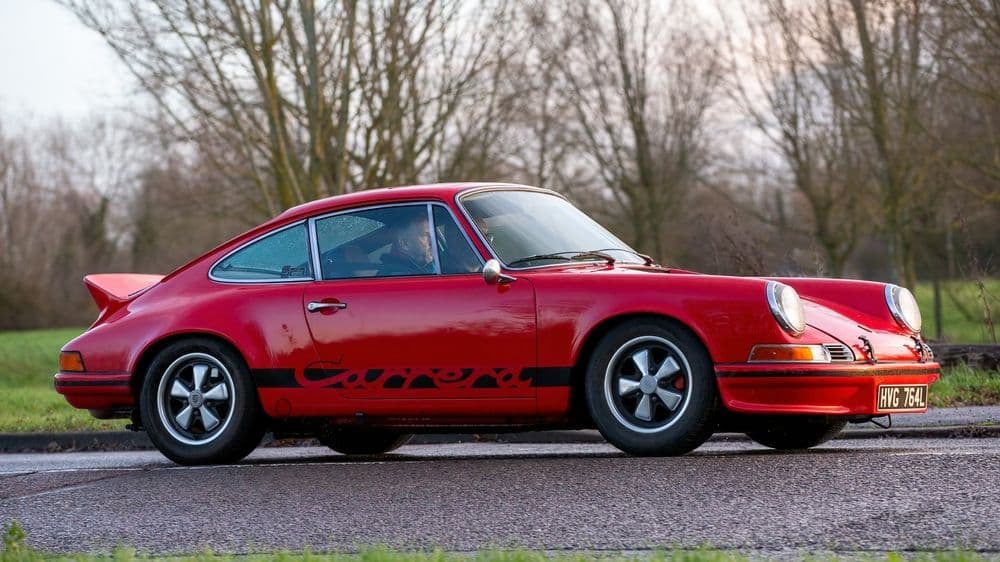
The RS lineage. The 1973 911 Carrera RS 2.7 is the template the entire collector market reads from. Porsche built 1,580 across all variants: 1,308 Touring (option M472), 200 stripped-out Lightweights (M471), 17 base homologation cars, and 55 RSR competition models. The Lightweight, rarer and faster of the two road versions, sits at the top of the band. Clean, matching-numbers examples trade from roughly $800,000 to north of $1.5 million depending on documentation, per recent RM Sotheby's results and the Hagerty Price Guide. The RS badge is the lesson. Within almost every air-cooled generation, the homologation or RS variant is the car that compounds, and the standard Carrera is the one that merely holds.
The 964 (1989 to 1994). The 964 has been the strongest percentage performer of the air-cooled generations, up roughly 69% over five years peak-to-peak on Condition 2 964 Carrera 2 examples, per Hagerty Price Guide and classic.com transaction data. The 964 Carrera RS, the European-market homologation special, now changes hands above $300,000. But the 964 is also where the recent softening shows up first. Hagerty's Porsche segment reading at the start of 2026 had mid-condition cars off 10 to 15% from their highs, part of what Hagerty flagged as the air-cooled market's first decline in five years.
The 993 (1994 to 1998). The last air-cooled 911 carries an "endpoint" premium that the market keeps reinforcing as collectors consolidate around finite series. The 993 Carrera RS and the air-cooled 993 Turbo anchor the upper tier, and the rare 993 GT2 (roughly 57 road cars) sits above both. A 1996 GT2 carried a $1.6 to $1.9 million estimate at Monterey in 2025, after a comparable example sold for roughly $2.4 million the year prior.
A word on what actually sets the price within a generation, because Porsche is where this discipline earns its keep. Two 1973 RS Tourings can sit a half-million dollars apart on documentation alone. The premium attaches to matching numbers, factory specification, and paper. Porsche's Certificate of Authenticity and the original Kardex production records are the closest thing this market has to clean title. Restomods, the Singer-rebodied cars and their many imitators, are a separate parallel market with their own demand curve. They are wonderful objects. They are not matching-numbers originals, and pricing one as if it were is a category error.
The Hypercar Tier: 959, Carrera GT, 918
Above the 911, Porsche has built three hypercars across three decades, each the technological halo of its era, and all three are now investment-grade by scarcity.

The 959 was the most technically advanced car in the world when it launched, and its 337-unit production keeps it genuinely scarce. The Sport variant, lighter and rarer, set its record at Amelia Island in 2026.
The Carrera GT is the one re-rating fastest, and the reason generalizes to the rest of the asset class. It is the last great analog hypercar: a 5.7-liter V10, a six-speed manual, no hybrid system, no electronic safety net. As the industry moves to hybrid and electric drivetrains, the Carrera GT has become the cleanest expression of a closing chapter, and the market is paying for the finality. Standard cars have climbed past $3 million, and the Gulf Blue Paint-to-Sample car cleared $6.715 million.
The 918 Spyder is the rarest case in modern collecting, a recent car that has appreciated above its sticker. It launched around $845,000. Clean examples, particularly with the Weissach package, now carry estimates in the $2.5 to $3 million range. That does not happen often, and when it does it tells you the car checked the scarcity and significance boxes the day it was built.
Above even these sit the motorsport halos: the 917, the 956 and 962, the 911 GT1 that headlined Broad Arrow's Monterey sale in 2024. They rarely come to market. When they do they print, and they are the closest Porsche analogue to Ferrari's pre-1970 blue chips.
Running the Carrying-Cost Math
Every car in this guide has already passed the Autobahn Alpha Four-Factor Screen: production scarcity, provenance integrity, buyer-base breadth, and cultural resonance. The second test is arithmetic. A collector car has to outrun its carrying costs, meaning storage, agreed-value insurance, and scheduled maintenance, before it earns a dollar of real return.
Porsche is forgiving on that math in a way most of the asset class is not, because the entry tickets are lower and the costs do not scale with price. A documented $300,000 air-cooled 911 carrying $4,000 to $6,000 a year in costs is paying roughly 2% of its value annually, a drag a compounding car clears comfortably. The same fixed costs on a $60,000 water-cooled 996 Carrera, a wonderful driver with high production volume and a flat value history, eat 8 to 10% a year. One of those is an investment. The other is a hobby with a depreciation schedule.
So the discipline reduces to one line: tier, specification, and documentation, not badge. Against the broader field, Porsche's profile is distinct. Ferrari offers a higher apex and a thinner middle. The broad collector market, as measured by Knight Frank's classic car sub-index, returned roughly 118% over the past decade, about 8% annualized, but grew just 1.2% in 2024 before stabilizing. Blue-chip Porsche, on the HAGI P reading, was close to flat through late 2024. The thesis was never that Porsche beats equities in every window. It is that the right tier compounds with thin correlation to the rest of a portfolio, and that you can actually get out of it.
The Modern "Instant Collectible" Question
Porsche manufactures scarcity on purpose now, and that creates a live trap for investors. The 911 R (991 built, 2016), the 992-generation S/T, the GT3 Touring, and the GT3 RS variants are all deliberately limited, allocation-controlled cars that routinely trade above sticker the moment they are delivered. Some hold the premium. The 911 R is the cleanest example. Others give it back within 24 to 36 months, as the next limited car arrives and the speculative bid moves on.
The honest framing is the one the Ferrari F80 raises in the same breath. A limited modern Porsche is investment-grade by production volume, but the buyer-base test plays out over a decade, not a delivery cycle. Paying the flip premium to a dealer's favorite client is not the same trade as buying a car whose value is already structural. The market sorts the two out slowly, and usually at the second owner's expense.
What to Watch in 2026 and 2027
The air-cooled softening as an entry, not an exit. The 10 to 15% retracement in mid-condition cars is the first real cooling in five years. Blue-chip buyers have historically accumulated into exactly this kind of moderation rather than chasing the top. The permanent scarcity, no more air-cooled cars ever, has not changed.
Generational demand rotation. Cerulli Associates projects roughly $124 trillion in wealth transfer through 2048, with Millennials inheriting more than any cohort before them. The collectors deploying that capital grew up with 911s on their walls and Gran Turismo on their screens. That is a structural tailwind under air-cooled cars, the RS lineage, and the Carrera GT in particular.
Hypercar re-rating risk. The $6.715 million Carrera GT print is the kind of move a disciplined allocator sizes against carefully rather than chases. A one-off Paint-to-Sample result is not the market clearing price for a standard car, and treating it as one is how segments overheat.
Structured access reaches the on-ramp. Porsche's combination of liquidity and lower entry tickets makes it the natural vehicle for fractional and SPV-structured exposure. For an investor who wants air-cooled or hypercar-tier Porsche in an alternatives sleeve without sourcing, storing, and insuring the car personally, the structures now exist, though diligence on fees, exit timing, and originality verification still varies by manager.
The Generation Is the Thesis, Not the Badge
Porsche is the marque where this asset class is most accessible and most liquid, and those two facts are really one. You can buy in at a tier that matches your capital, verify what you are buying through factory documentation, and sell it inside a normal year if the thesis or your circumstances change. That is rare in collector cars, and it is the reason Porsche is the on-ramp.
But liquidity cuts both ways. A market that reprices upward in a quarter reprices downward just as fast, and the air-cooled cooling is the reminder. The word "Porsche" is not the investment thesis. The generation, the specification, the documentation, and the tier are. Buy the car you can underwrite, hold it through a cycle, and let the scarcity do the work.
Frequently Asked Questions
Q: Is Porsche a good investment? At specific tiers, yes, and more broadly than almost any other marque. Air-cooled 911s (1964 to 1998), the RS homologation cars, and the hypercar tier (959, Carrera GT, 918 Spyder) have compounded across market cycles. Production-volume water-cooled cars (base 996, 997, and 991 Carreras) generally do not appreciate enough to clear their carrying costs. The deciding factors are tier, specification, and documentation, not the badge alone.
Q: Which Porsche is the best investment? For most accredited investors, a documented, matching-numbers air-cooled 911 in the right specification, whether a Carrera RS, a clean 964 or 993, or an air-cooled Turbo, offers the best balance of entry price, liquidity, and appreciation history. At the top sit the 1973 Carrera RS 2.7 Lightweight and the hypercar tier (Carrera GT, 959, 918 Spyder). The single best percentage performer in recent years has been the 964 generation, up roughly 69% over five years before the recent cooling.
Q: Are air-cooled Porsches still going up in value? Not at the moment. After years of steady appreciation, Hagerty flagged the air-cooled market's first decline in five years, with mid-condition cars off roughly 10 to 15% from their highs at the start of 2026. Historically, blue-chip buyers treat that kind of softening as an accumulation opportunity rather than a warning, because the underlying scarcity (Porsche will never build another air-cooled car) is permanent.
Q: Is the 964 or the 993 a better investment? They play different roles. The 964 has delivered stronger percentage gains and remains relatively more affordable, giving it more room to run but more volatility. The 993, as the last air-cooled 911, carries a premium and tends to be the more stable store of value, with the 993 Carrera RS, Turbo, and GT2 anchoring the top. Documentation and originality matter more than the generation in either case.
Q: Are modern limited 911s like the 911 R or GT3 RS good investments? They are investment-grade by scarcity, but the buyer-base test takes a decade to resolve. Cars like the 911 R (991 built) and the 992 S/T are deliberately limited and often trade above MSRP at delivery. Some hold that premium; many give it back within two to three years as the next limited model arrives. Paying a large flip premium at delivery is a different and riskier trade than buying a car whose value is already structural.
Q: How do I invest in a Porsche without buying one outright? Fractional and SPV-structured ownership platforms now offer accredited investors exposure to investment-grade Porsches, both air-cooled 911s and the hypercar tier, without sourcing, storing, insuring, and certifying the car personally. The structures professionalize the operational burden at the cost of some control. For an allocator, structured exposure to a documented blue-chip Porsche is often more practical than sole ownership.

Joseph Chappius — Automotive Journalist
Fifteen years in wealth management. Now writing about collector cars, alternative assets, and the stories behind them. All articles →
-800x530.jpg&w=3840&q=75&dpl=dpl_EjU4dBitZy5nVicrEdyatuixxDFz)
-800x400.jpg&w=3840&q=75&dpl=dpl_EjU4dBitZy5nVicrEdyatuixxDFz)
-800x534.jpg&w=3840&q=75&dpl=dpl_EjU4dBitZy5nVicrEdyatuixxDFz)