The Aventador Is Already Appreciating. Here's Why That's Surprising.
Key Takeaways
- Lamborghini built 11,465 Aventadors between 2011 and 2022 — more than the Countach, Diablo, and Murciélago combined. High production normally caps collectibility. This one is the exception.
- The appreciation is concentrated, not universal. The halo trims (SVJ, Ultimae) and clean, low-mileage cars are holding at or above their original stickers; high-mileage base coupes have mostly just stopped falling.
- The thesis in one sentence: the Aventador is the last pure naturally aspirated, non-electrified V12 Lamborghini. The hybrid Revuelto closed the book, and the market priced it.
- It's the same mechanic that re-rated the Ferrari 458. The last analog engine in a marque's signature line becomes a finite set the moment its successor changes the formula.
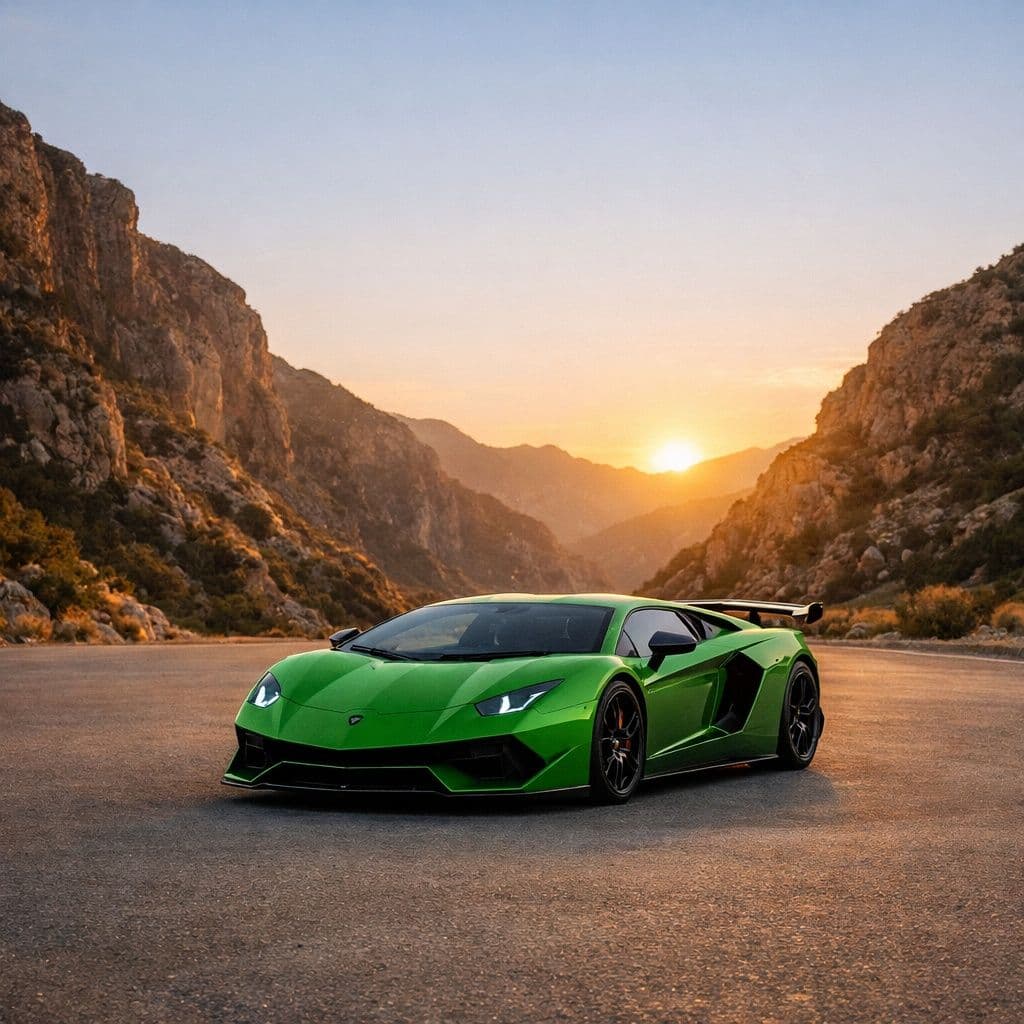
A modern supercar built in five figures of volume, criticized at launch for the way it drove, and superseded three years ago is not supposed to be an appreciating asset. The Lamborghini Aventador is all three of those things. And the best examples are now worth more than they cost new.
That sentence would have read as a typo a decade ago. Lamborghini delivered 11,465 Aventadors across an eleven-year run, per the company's own production figures reported by evo — a car more numerous than the Countach, Diablo, and Murciélago combined. Volume is usually collectibility's enemy. Scarcity is the first thing any serious buyer underwrites, and the Aventador, on paper, has none.
Yet the auction record keeps pointing the other way. The Aventador SVJ trades around its 2019 sticker and, at the top, well above it. The farewell Ultimae changes hands for more than it cost new. Even the base LP 700-4, the one that depreciated like any other exotic for most of the last decade, has stopped falling. Something is overriding the volume problem. It's worth understanding what, because the same force is quietly re-rating cars across the modern supercar market.
How Many Aventadors Did Lamborghini Build? Why the Numbers Argue Against It
Three strikes against it: five-figure production, a gearbox the press never forgave, and the default fate of any modern supercar — depreciation.
Start with the production math, because it's the strongest argument against the car.

The Aventador outsold its three predecessors put together. Lamborghini under Volkswagen Group ownership simply operated at a different scale than the company that hand-built Countaches in Sant'Agata in the 1980s. More cars, by definition, means more survivors, more supply at any given moment, and less of the knife-edge rarity that drives a 250 GTO or a Miura SV.
Then there's the car itself. The Aventador launched to genuine awe at its 6.5-litre V12 and genuine frustration at almost everything around it. The single-clutch ISR gearbox, Lamborghini's "Independent Shifting Rod" automated manual, shifted with a violence reviewers described as charming at best and crude at worst. The chassis understeered. Critics called it a point-and-shoot car, fast in a straight line and stubborn everywhere else, and unfavorably compared its driving experience to the Ferraris and McLarens of the era. This was not the purist's darling the Murciélago had been.
And modern supercars depreciate. That's the base rate. A six-figure exotic typically sheds a meaningful share of its value in the first several years as the next new thing arrives and the original buyer moves on. Nothing about a high-volume, much-criticized flagship suggests it should escape that gravity.
So why has it?
Which Aventadors Are Actually Appreciating? SVJ, Ultimae, and the Base Car
The story isn't "the Aventador is up." It's that the right Aventadors are holding or rising while the broad market for modern exotics has softened.
Begin with the SVJ, the track-honed peak of the range. Across the 15 SVJ sales tracked by The Classic Valuer, the median result is about $520,000 (£409,200) — close to the car's original $517,770 sticker from 2019. The sell-through rate is a healthy 65%, and the spread runs from roughly $405,000 (£320,664) to a high of $1,170,000 (£922,383), a Bring a Trailer sale in July 2025. A Broad Arrow sale at Amelia Island in March 2025 cleared $975,000 (£769,162). For a six-year-old car produced in roughly 1,700 examples across coupe and roadster, holding the line on sticker, and beating it for the best cars, is the opposite of what depreciation curves predict.
The Ultimae, the literal farewell edition, makes the point more bluntly. Lamborghini capped it at 600 cars (350 coupes and 250 roadsters) and pitched it as the send-off: the last of the line. It launched at roughly half a million dollars. The Classic Valuer's auction record shows nine Ultimae sales at a median of about $705,000 (£554,502), with a range of roughly $570,000 to $830,000 (£450,590 to £652,678), comfortably above that sticker and sustained since production ended. The sell-through rate is a thinner 47%, a fair reminder that these are illiquid cars that don't always meet reserve.
There's a footnote that tells you how much they're valued: when the cargo ship Felicity Ace sank in 2022 with a number of the final cars aboard, Lamborghini reopened the production line specifically to rebuild them.
The base LP 700-4 is the honest counterweight. It launched at $379,700 in 2011 and depreciated for most of the following decade, as expected. What's changed is that the curve has flattened and, for clean low-mileage cars, begun to firm. The entry point into V12 ownership is no longer in free-fall.
Put those three together and the headline needs a qualifier. The Aventador isn't uniformly appreciating. The halo trims and the well-kept cars are holding or rising; the tired, high-mileage base coupes are simply done falling. That bifurcation, the top and the best firming while the middle and bottom lag, is the same pattern playing out across the broader collector market, and it's the tell that something structural is at work rather than a passing fad.
Why Is the Aventador Appreciating? The Last Naturally Aspirated V12
The Revuelto is a hybrid. Lamborghini has signaled the unassisted V12 isn't coming back. That turns the Aventador into a closed set — the last analog twelve from Sant'Agata.
Here's the force overriding the volume problem. The Aventador is the end of a bloodline.
Its successor, the Revuelto, launched in 2023 with a new 6.5-litre V12 paired to three electric motors, a hybrid producing north of 1,000 horsepower. It's a remarkable machine, and it is not the same kind of object. The Aventador is the last Lamborghini flagship with a naturally aspirated V12 and nothing else: no turbos, no electric assist, no battery. Just twelve cylinders, a redline past 8,000 rpm, and the noise that has defined the marque since the Miura.
That matters because the thing being made finite isn't a car. It's an experience that regulation and electrification have made non-replicable. Emissions and efficiency rules are squeezing large-displacement naturally aspirated engines out of existence across the industry. Lamborghini's own future is hybrid and, eventually, electric. When the defining characteristic of a car can no longer be manufactured (at any price, by anyone), the existing population stops being "used inventory" and becomes the entire supply that will ever exist.
The market has seen this movie before. The Ferrari 458 was the last naturally aspirated V8 Ferrari before the turbocharged 488 arrived in 2015. The 458 didn't follow the depreciation script; it held far better than the more powerful 488 that replaced it. The track-focused 458 Speciale, which stickered around $290,000 in 2013, now carries a median of about $445,000 (£350,664) across the 54 sales The Classic Valuer tracks, with the strongest recent results pushing past $865,000 (£680,725), a clear step up from sticker.
Same mechanic, different marque: the last analog engine in a signature line becomes a closed set the moment its successor changes the formula. The Aventador is Lamborghini's version of that trade. (We unpack the broader pattern in our companion piece on what happens to a supercar's value the moment its replacement is announced.)
How Rare Is the Aventador SVJ? Scarcity Inside the Volume
11,465 is the wrong denominator. The cars doing the work were built in the hundreds, not the thousands.
The volume objection is real, but it measures the wrong thing. "The Aventador" isn't one car; it's a decade of variants, and the ones appreciating are genuinely scarce.

A run of 900 SVJ coupes is not 11,465 cars. It's a scarce, specification-defined object with a clear identity: the most extreme naturally aspirated V12 road car Lamborghini ever signed off, and it carries the provenance, registry, and cultural weight that the broad production number obscures. The same four-factor screen Autobahn Alpha applies to any marque holds here: production scarcity at the trim level, provenance integrity, a global buyer base, and cultural resonance. The SVJ clears all four — a documented, registry-tracked car with a worldwide bidder pool and cultural resonance the Aventador has in abundance, thanks to a decade as the default poster car and the last unfiltered V12 soundtrack. The base car fails the scarcity test. The halo trims pass it comfortably. The denominator that matters is the one printed on the build sheet for that specific variant, not the model line as a whole.
What Are the Risks of the Aventador as an Investment?
The thesis is real and partly spent. The easy money in the SVJ and Ultimae has already been made, and not every Aventador is an investment.
Sophisticated buyers will see the obvious counterarguments, so we'll name them.
The premium is already in the price. The "last analog V12" narrative isn't a secret; it's the consensus, and the SVJ and Ultimae trade where they do precisely because the market already believes it. Buying the thesis today means buying it at the price the thesis has already produced. The asymmetry that existed in 2023, when these cars were still treated as depreciating exotics, has narrowed.
Bifurcation cuts both ways. A high-mileage LP 700-4 with a patchy history is not the Ultimae, and treating "the Aventador" as a single appreciating asset is the fastest way to overpay for the wrong example. Selectivity does the work here, as it does across the asset class.
And the carrying costs are real. A V12 Lamborghini is expensive to insure, service, and store; clutches, electronics, and the ISR gearbox on early cars are not cheap to maintain, and condition is fragile in a way that punishes the careless. Liquidity is thinner than the headline auction results suggest: a 65% SVJ sell-through means roughly a third of cars offered didn't meet reserve. Past performance, as ever, does not guarantee future results, and a car bought as an investment is still a depreciating machine until the market decides otherwise.
Which Supercars Could Re-Rate Next?
The signal isn't the Aventador's price. It's whether the next analog flagships start trading the same way before their successors even arrive.
The instructive thing about the Aventador isn't the car. It's the template. Across the supercar market, the naturally aspirated, internal-combustion flagship is being retired marque by marque, and the last clean examples of each are the ones to track. The Audi R8 and Lamborghini Huracán, the last naturally aspirated V10s, ended their runs in 2024; the R8 bowed out without a direct successor, while the Huracán gave way to the twin-turbo hybrid Temerario. The Mercedes-AMG SLS, the last hand-built naturally aspirated V8 from AMG, is firming. Each is a candidate for the same re-rating the Aventador is living through, and each will be priced by the same question: did the successor preserve the defining trait, or kill it?
So, Is the Aventador a Good Investment?
The Aventador breaks the volume rule because it's measured against the wrong rule. Production scarcity matters, but it's not the only factor that compounds value, and in this case it's outweighed by something rarer than a low build number: a characteristic that can no longer be made. The last naturally aspirated V12 Lamborghini is a finite, closing set, and the market figured that out before the obituaries were written.
That doesn't make every Aventador an investment. It makes the right Aventador (a scarce trim, clean history, low miles, the full provenance file) a legitimate satellite holding in a collection built on the same logic that governs the rest of the asset class. The surprise isn't that a high-volume modern supercar is appreciating. The surprise is how cleanly it confirms the thesis that scarcity of experience, not just scarcity of units, is what the market ultimately pays for.
Frequently Asked Questions
Q: Is the Lamborghini Aventador a good investment?
Selectively. The SVJ, Ultimae, and other halo trims, in clean low-mileage condition with full provenance, are holding at or above their original stickers — unusual for a modern supercar. High-mileage base LP 700-4 coupes have stopped depreciating but aren't appreciating meaningfully. As with any collector car, the specific example and trim matter far more than the model name, and carrying costs and illiquidity should be priced in.
Q: Why is the Aventador appreciating despite high production?
Because it's the last Lamborghini flagship with a pure naturally aspirated V12 and no electrification. Its successor, the Revuelto, is a hybrid, and Lamborghini has signaled the unassisted V12 won't return. That makes the Aventador a finite set of an experience emissions rules have rendered non-replicable. Scarcity of the characteristic outweighs the high unit count, especially at the genuinely rare halo trims.
Q: How many Lamborghini Aventadors were built?
Lamborghini built 11,465 across the 2011–2022 run, more than the Countach (1,983), Diablo (2,903), and Murciélago (4,099) combined. But the appreciating variants were built in far smaller numbers — 900 SVJ coupes, 800 SVJ roadsters, 600 Ultimaes, and just 63 SVJ 63s.
Q: What is the Aventador SVJ worth now?
Across the 15 SVJ sales tracked by The Classic Valuer, the median is about $520,000 (£409,200) — near its 2019 $517,770 sticker — with a 65% sell-through and a high of $1,170,000 (£922,383) at a July 2025 Bring a Trailer sale. US-market clean examples have traded from the high-$300,000s to over $900,000 depending on mileage, specification, and provenance.
Q: Is the Aventador Ultimae a better investment than the SVJ?
They're different cases. The Ultimae is the factory's literal farewell (600 cars) and carries the cleanest "end of an era" story, trading at a premium over its roughly $500,000 sticker — a $705,000 (£554,502) median across nine tracked sales. The SVJ is the dynamic peak and more numerous, trading nearer its original price. Both are halo trims; the Ultimae leans on finality, the SVJ on performance pedigree.
Q: Will the Lamborghini Revuelto appreciate like the Aventador?
Unlikely to follow the same path. The Revuelto is the new flagship, not the end of a bloodline, and new exotics typically depreciate before any collector thesis forms. The Aventador's appreciation comes specifically from being the last of something. A car at the start of the hybrid era doesn't have that scarcity-of-characteristic on its side — at least not yet.

Joseph Chappius — Automotive Journalist
Fifteen years in wealth management. Now writing about collector cars, alternative assets, and the stories behind them. All articles →