Your Portfolio Is on Fire: Go Buy a Ferrari

Key Takeaways
Five of the ten biggest collector-car auction sales of 2025 wore a Ferrari badge. That’s a function of scarcity, global demand, and brand durability, not coincidence. “Ferrari as an investment” collapses three different markets: pre-1970 blue chips, limited production modern halo cars, and everything else. Only the first two tiers produce reliable long-term appreciation. Tier three often behaves like a depreciating luxury good once carrying costs are included. The 2026 modern hypercar surge is real but worth watching. Enzo auction records tripled in a single quarter. That’s 1989-adjacent behavior in a specific segment, not a blanket signal.
Q1 2026 was a strange quarter to be long traditional assets. Hormuz shipping was throttled, Dubai crude touched $166, and the VIX spiked above 30 by late March. Equities wobbled.
Collector cars did not wobble.
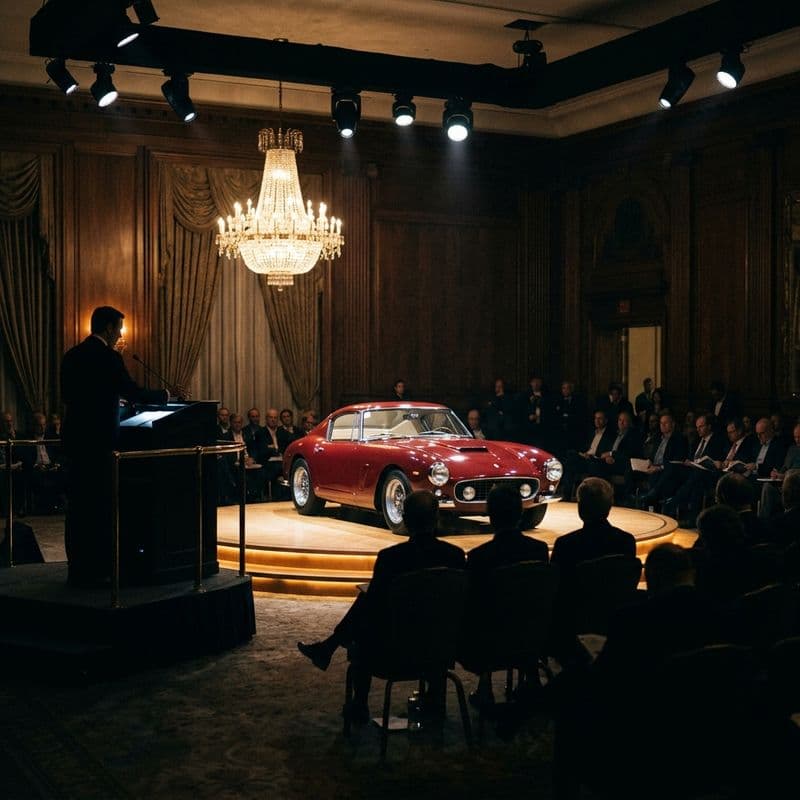
On January 17, at Mecum Kissimmee, a one-of-one 1962 Ferrari 250 GTO “Bianco Speciale” sold for $38.5 million. Eleven days later in Paris, RM Sotheby’s posted its highest-grossing European sale ever at €81 million, topped by a 1960 250 GT SWB California Spider at €14 million.
In the first week of March, Broad Arrow’s Amelia Island sale set multiple new world auction records, including the Porsche Carrera GT, 959 Sport, and Lamborghini Miura SV. Per Hagerty’s year-end tally, five of the ten biggest collector-car auctions of 2025 were Ferraris.
The phrase “Ferrari as an investment” flattens something important. Ferrari isn’t one market. It’s three.
One is a genuine blue chip. One is a modern halo tier repricing in real time. The third, which covers most of what Ferrari has ever built, is a depreciating luxury good with a red paint job. Telling them apart is the entire job.
Why Ferrari Dominates the Top of the Collector Market
A 1954 Mercedes-Benz W196 R streamliner took the top spot on the 2025 leaderboard at $53 million (RM Sotheby’s Stuttgart). Ferraris took the majority of the remaining top-ten slots, including Michael Schumacher’s $18.4 million F2001. No other marque comes close at the apex. Porsche makes more cars collectors want to own. Mercedes has the deeper racing history. But Ferrari has owned the top of the market for four decades.
Three mechanics explain it.
Scarcity is brutal at the top. Ferrari built exactly 36 250 GTOs between 1962 and 1964, and all 36 are accounted for. The production run of 32 Ferrari 250 LMs is similarly intact.
The halo catalog is deep. 250 GTO, 250 GT SWB, 250 Testa Rossa, 275 GTB/4, 288 GTO, F40, F50, Enzo, LaFerrari, F80. No single model carries the investment thesis alone.
Demand is genuinely global. RM Sotheby’s reported bidders from 82 countries in 2025, with 46% of bidders first-timers. When wealth concentrates in the Gulf, in Asia, in Latin America, a disproportionate share routes toward Maranello.
The Three Tiers of Ferrari as an Investment
The framework below separates Ferrari’s catalog into three groups with fundamentally different return profiles. Most commentary about “Ferrari as an investment” conflates them. That’s how Tier 3 cars end up sold on Tier 2 math.
Tier 1: The Pre-1970 Blue Chips
These are the cars that set auction records and don’t give them back. Publicly, GTOs trade between roughly $38 million and the mid-$50 millions. Private sales have pushed higher. The $70 million WeatherTech founder David MacNeil paid in 2018 for 250 GTO chassis 4153GT remains the high-water mark. The current public- auction record is $51.7 million (1962 250 GTO/330 LM, RM Sotheby’s New York, November 2023)
The Bianco Speciale’s $38.5 million result in January 2026 landed at the softer end of that public range. Chassis history, racing pedigree, and originality still determine where in the band a given GTO prices.
The rest of Tier 1 includes the 250 GT SWB (Paris 2026: €14 million), the 250 Testa Rossa, the 275 GTB/4 NART Spider, and a narrow list of pre-war and early postwar racing Ferraris. What unites them: fewer than 200 built across all variants, strong provenance, and the core traits that define what makes a car collectible
These behave less like vehicles and more like finite cultural assets. The $5 to $70 million entry ticket puts direct ownership out of reach for virtually every accredited investor.
Tier 2: Modern Halo Ferraris, the Allocator’s Sweet Spot
The “Big Five” plus the new F80 form a second investment-grade tier, backed by engineering significance and deliberately constrained production.
For accredited investors with genuine but non- institutional capital, this is where the Ferrari investment math actually works.
288 GTO (272 Units Produced)
$3 to $4M range per Hagerty for good examples
F40 (1,315 Units Produced - 1,311 customers)
$2 to $3M base; F40 LM by Michelotto $11M at RM Sotheby’s Monterey Aug 2025
F50 (349 Units Produced)
Ralph Lauren’s Giallo Modena F50 sold for $9.245M at RM Sotheby’s Monterey Aug
2025, a 68% jump over the prior F50 auction record
Enzo (400 Units Produced)
Auction record tripled to $17.875M at Mecum Kissimmee Jan 2026; five Enzos traded
above $9M in Q1 2026
LaFerrari (499 + 210 Aperta Units Produced)
$2.8M fair, $4.5M+ well-kept, some Aperta examples trading above $10M
F80 (799 Units Planned)
3.0L twin-turbo hybrid V6; delivery through 2027
Sources: RM Sotheby’s, Hagerty Insider, Classic Driver, Sotheby’s Ferrari production
reference.
Production numbers are deceptive. The F40’s 1,315-unit run looks large next to 250 GTO scarcity, but within the modern hypercar category it’s small, and attrition has tightened effective supply.
The Enzo’s 2026 move is a signal worth taking seriously in both directions. Auction records tripled to nearly $18 million in a single quarter, and several Enzos traded above $9 million. That’s up from a sub-$5 million auction record set in prior years.
That magnitude can be a fundamental repricing driven by recognition that the V12 halo era is closing. Or it can be early speculation. Probably both.
Sized sensibly, that compounding is what an allocator is hunting. Sized aggressively, it’s the 1989 Daytona trade in a modern wrapper.
Tier 3: Everything Else
Ferrari has built over 230,000 cars in its history. Tiers 1 and 2 account for a few thousand. The remaining 99%-plus (360s, 430s, 458s, California Ts, Portofinos, most 550s and 575s) does not appreciate in any meaningful way once you account for maintenance, storage, insurance, and opportunity cost. Hagerty’s segment data for production-era Ferraris (360, F430, 458) has moved sideways over the last four quarters. These cars can be wonderful to own. They are not investments.
When a salesperson uses the phrase “Ferrari as an investment” without specifying which Ferrari, they’re usually selling a Tier 3 car priced like Tier 2. For the allocator, Tier 3 is an enthusiast’s purchase. That’s fine, as long as it isn’t priced as an investment thesis.
Ferrari vs. the Rest of the Alt-Asset Field
Ferrari 250 GTO
$51.7M (RM Sotheby’s, 2023)
$38 to $70M
McLaren F1
$25.3M (RM Sotheby’s Abu Dhabi, Dec 2025)
$18 to $25M
Porsche Carrera GT
$6.7M (Broad Arrow Amelia Island, March 2026)
$1.4 to $1.8M excellent
Porsche 959 Sport
$5.5M (Broad Arrow Amelia Island, March 2026)
$1.5 to $2.5M standard
Mercedes W196 R
$53M (RM Sotheby’s Stuttgart, Feb 2025)
$20M+ private estimates
Sources: RM Sotheby’s, Broad Arrow, Hagerty Market Trends.
McLaren F1 is the tightest comparison, but McLaren has exactly one halo car. Ferrari has seven across six decades, plus a Tier 1 catalog no competitor can match.
For context on collector cars as an asset class: Knight Frank’s 2023 Wealth Report cited classic cars up roughly 118% over the prior decade, about 8% annualized.
More recent readings are much softer. The collector-car index grew just 1.2% in 2024 before modestly rebounding. Within a basket that has gone sideways, Tier 1 and Tier 2 Ferraris continue to pull the top-end numbers upward.
The thesis isn’t that Ferrari beats the S&P over every period. It’s that these two tiers have compounded at rates that justify a satellite allocation, and that correlations with equities are thin enough to matter in quarters like the one just past.
What Can Go Wrong
The 1989 Ferrari bubble sits behind every Maranello auction. Ferrari values rose roughly 900% in the five years to 1989, pulled upward by Japanese buyers flush with real-estate-bubble cash. By the mid-1990s many of those cars traded at 25% of peak. A $500,000 Daytona became a $125,000 car. Today’s buyer base is broader and less leveraged: 82 countries, 46% first-time bidders. That’s structurally healthier than a single-country wave.
But the recent Enzo move is exactly the kind of price action that preceded the 1989 correction in specific segments. Sophisticated allocators treat any asset that triples in a quarter as a signal to size carefully, not to chase.
Two other risks are worth naming.
Provenance fraud. At eight-figure prices, documentation is the asset. Ferrari Classiche certification and rigorous chassis history are not optional on a Tier 1 car.
Carrying costs that scale unfavorably. A $50M GTO costs roughly the same to store, insure, and maintain as a $5M F40. On the GTO, trivial drag. On a sub-$1M car, storage and insurance alone can run 2 to 3% annually. That’s why Tier 3 is usually a break-even-at-best proposition.
What to Watch in 2026 and 2027
End-of-V12-halo scarcity premium. Ferrari walked back its EV ambitions in October 2025. The 2030 EV target was cut from 40% to 20%, and V6, V8, and V12 powertrains are slated to continue well into the next decade. Combustion is not ending at Ferrari. But the F80’s hybrid V6 still marked a quiet break from the V12 halo lineage that ran from Enzo through LaFerrari. The market is repricing the F50, Enzo, and LaFerrari as the last V12 halo trilogy.
Expect upward pressure on Tier 2 with higher volatility as speculators test the ceiling.
Generational demand rotation. Cerulli projects roughly $124 trillion in wealth transfer through 2048, with Millennials inheriting more than any other cohort.
The collectors deploying that capital grew up with F40 posters on their bedroom walls, not 250 GTOs in historical racing footage. That’s a tailwind for Tier 2 and a headwind for parts of Tier 1.
What doesn’t change: the supply. There will never be a 37th 250 GTO. There will never be a 401st Enzo. The scarcity is permanent.
The 250 GTO Buyer Isn’t Betting on Ferrari
MacNeil’s 2018 $70 million bet wasn’t on Ferrari the company, or on Italian sports cars as a category, or on the direction of the collector market. It was on the continued existence of 36 specific physical objects in a world where capital keeps concentrating in fewer hands and fewer asset categories. Historically, that trade has worked.
Tier 2 is where the same logic compounds for accredited capital rather than dynastic capital. The Enzo’s recent move is proof of the opportunity and warning of the risk in the same data point. Sized appropriately, those cars belong in an alternatives sleeve. Sized aggressively, they’re the 1989 Daytona trade in modern packaging.
Tier 3 is a car. A wonderful one, often. Not an investment.
For allocators with a satellite tolerance for illiquidity, a multi-decade horizon, and a preference for assets that don’t move when everything else does, the top two tiers have earned their place in the conversation. Just know which tier you’re buying. The word “Ferrari” alone isn’t the investment thesis.
The specific car is.
Frequently Asked Questions
Q: What’s the best Ferrari to invest in?
At the blue-chip end, pre-1970 racing Ferraris
with documented provenance (250 GTO, 250 GT SWB, 250 Testa Rossa) have
delivered the most consistent long-term appreciation. For most accredited investors,
limited-production modern halo cars (F40, F50, Enzo, LaFerrari) are where the math
actually works, with higher volatility but vastly lower entry tickets. The worst investments
are production-run modern Ferraris (most 360s, 458s, California Ts), which typically
depreciate once carrying costs are included.
Q: How much does a Ferrari 250 GTO actually cost?
The highest known private sale is $70 million (chassis 4153GT, 2018). At public auction, the record is $51.7 million (RM
Sotheby’s New York, November 2023). Recent sales have ranged from $38.5 million
(Mecum Kissimmee, January 2026) to the mid-$50 millions.
Q: Why are modern Ferrari halo cars appreciating so fast in 2026?
Three reasons. Ferrari’s partial transition to electrification has made V12 halo cars structurally scarcer.
A new generation of wealthy collectors grew up wanting these specific cars. And the
broader hypercar market has become a magnet for capital. Enzo auction records tripled
to $17.875 million at Mecum Kissimmee in January 2026, with several examples trading
above $9 million in the same quarter. Whether that’s a durable repricing or a speculative
spike is the most important question in the segment.
Q: What separates a Ferrari that’s an investment from one that isn’t?
Three factors: production volume (under 500 cars is generally the halo-tier threshold), brand
and chassis significance (competition history, halo status, design importance), and
buyer-base breadth (global versus single-region demand). Most Ferraris fail at least one
of these tests.
Q: Is the current Ferrari market in a bubble like 1989?
The late-1980s bubble was driven by a single leveraged cohort of Japanese buyers. By 1994, many cars had fallen
to 25% of peak. Today’s buyer base is broader (82 countries, 46% first-time bidders)
and less leveraged. That’s structurally healthier. But the recent Enzo surge and F50
record are exactly the kind of price action that preceded the 1989 correction in specific
segments. Size carefully.
Q: How do you invest in a Ferrari without spending $50 million?
Fractional and SPV-structured ownership platforms now offer accredited investors exposure to
investment-grade collector cars without direct ownership. These structures
professionalize storage, insurance, Classiche certification, and exit timing, at the cost of
some control. For most allocators, structured exposure to a Tier 1 or Tier 2 Ferrari is
more practical than sole ownership. [See companion piece: “The Ferrari Access
Problem: How Accredited Investors Are Actually Getting In.”

Joseph Chappius — Automotive Journalist
Fifteen years in wealth management. Now writing about collector cars, alternative assets, and the stories behind them. All articles →