Before the Ferrari F40, There Was the Miura — and It Changed Everything
Autobahn Alpha
AUG 2, 2026 · 7 min read
Key Takeaways:
- The term supercar existed before the Miura, but this Lamborghini popularized it
- The Miura successfully transferred mid-engine placement, a setup mostly reserved for racing, to a performance road car, a ground-breaking feat for the 1960s
- When evaluating the Lamborghini Miura vs. the Ferrari F40, it’s essential to recognize that the Miura arrived more than two decades before the F40
- Most supercars since the Miura have featured a mid-engined layout, including Ferrari’s F40
- The Lamborghini Miura P400 SV is considered the most technically dynamic version of the Miura’s supercar formula.
- Determining how much a Lamborghini Miura is worth depends on factors like the model’s originality, mileage, condition, documentation, and story.
Before the F40, the Miura Kicked-off Mid-Engine Supercar History
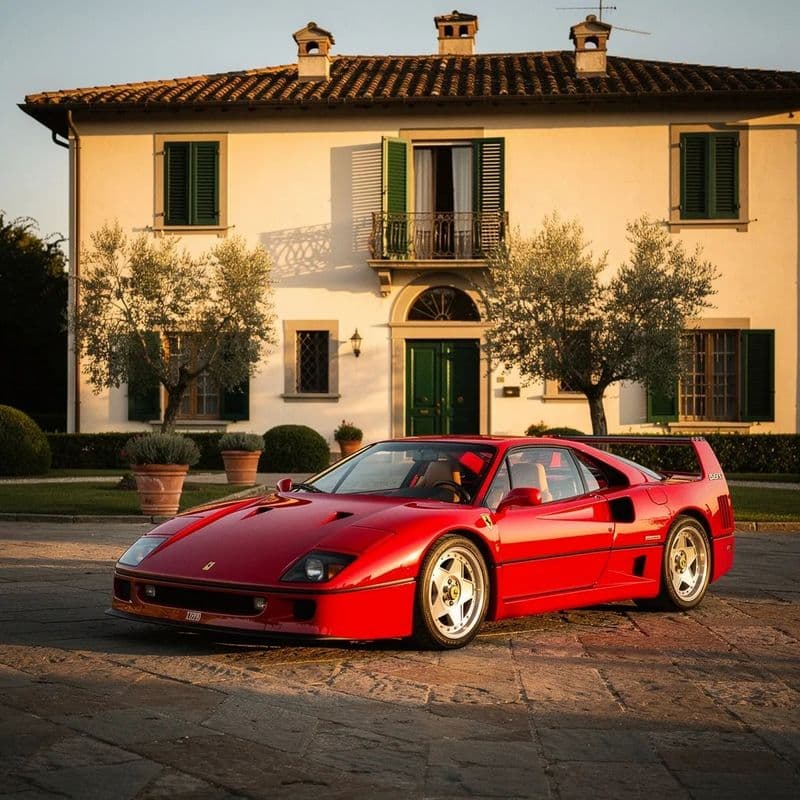
There’s a relatively common misconception that Ferrari’s F40 (1987 to 1992 model years) marked the beginning of supercars as we know them, but Lamborghini’s Miura (1966 to 1973) laid this blueprint two decades earlier. Ferrari’s F40 is more representative of the modern high-performance, stripped-down halo supercar, and the Miura influenced it in more ways than one.
The term supercar technically existed before the Miura, with London newspaper, The Times, using the term in 1920 to refer to the Ensign 6. This early-20th century vehicle was a Bentley Speed Six Rival boasting cutting-edge features (for the time) like fabric seats, a silent third gear, and what was described as a “neck-breaking” 38.4 horsepower. Car Life Magazine also referred to the Pontiac GTO as a supercar in 1965, with its robust V8 installed in a lightweight vehicle. However, the term became more defined after the Miura’s release.
Iconic automotive writer L.J.K Setright’s description of the Miura from his 1,000-mile driving review of the vehicle in 1967 and 1968 editions of CAR Magazine aligns with today’s perception of supercars: “This dramatically conceived Lamborghini can be employed for what it is – an immensely fast, modern two seater with the world’s finest engine, society’s highest cachet, and plenty of scope for further development.”
The Miura ultimately set a new benchmark for car design, layout, and desirability, redefining how exotic successors were measured.
The Supercar Existed Before the Word Did
Before the Miura’s 1966 release, the front-engine, rear-wheel drive grand touring (GT) formula dominated high-performance cars. Prime examples include, but aren’t limited to, Aston Martin’s DB5, Ferrari’s 250 GT Lusso, and Jaguar’s E-Type. This setup was meant to offer the best of both worlds, blending comfort, performance, and luxury that could hold up against long-distance travel. Pre-1966 Grand Tourers were overwhelmingly front-engine models, a layout maximizing space for comfort, balancing weight distribution with rear-wheel drive, facilitating cool airflow for long-distance performance, and simplifying mechanics. Before the Lamborghini Miura, mid-engine placement was largely reserved for racing.
Society of Automotive Engineers’ Lindsay Brooke explained: “Leading-edge racecar engineers, such as those at Auto Union and Mercedes-Benz in the 1930s, chose mid-engine over alternative powertrain layouts to minimize the vehicle’s polar moment of inertia.”
In racing terms, this decision meant sharper turn-in and faster directional changes due to a more centrally balanced chassis. Transferring a mid-engine layout from the racetrack to a passenger car was riskier. First, front-engine placement gives designers more flexibility with how the car will look since major mechanical components are consolidated up front. Mid-engine configurations also have less cabin room, lower cooling efficiency, and more complicated mechanical access for servicing. Lamborghini would take these constraints and use them to build something new.
Mid-Engine Supercar History: How Lamborghini Created a New Category
In the mid-1960s, Lamborghini’s founder, Ferruccio Lamborghini, wanted to build a GT car that would outperform any Ferrari, using a 12-cylinder engine developed for the company by ex-Ferrari engineer Giotto Bizzarrini. Ferruccio gave the 12-cylinder engine to young Lamborghini engineers Giampaolo Dallara and Paolo Stanzani, but the two employees weren’t keen on installing it in a traditional GT. While the Dallara and Stanzani frame was better suited to a sports car than to a V12, they reconfigured the drivetrain by mounting the transmission directly to the engine in a transverse rear mid-engine layout.
Dallara explained: “The original idea was to use that Mini’s [Cooper] ingenious front-wheel-drive engine and transmission and place it behind the driver to make a mid-engine car.”
After placing wheels on the frame with the engine fitted, Lamborghini displayed the work at the Turin car show in 1965. Besides the mid-engine placement, the display featured race-derived solutions such as an independent double-wishbone suspension and a lightweight emphasis.
The structure’s lightness (and rigidity) primarily stemmed from a folded and drilled 0.8-millimeter-thick steel sheet, and its total weight of 120 kg (264.5 lb) was groundbreaking at the time. It was mostly perceived as an unconventional prototype rather than a defining shift, underscoring how several high-value collectibles started with early misunderstanding. Still, Lamborghini received multiple orders from the showcase alone. Now the automaker needed a body.
From Chassis to Body: The Design Constraints Behind the Miura
Italian automotive coachbuilder Carrozzeria Touring saw Lamborghini’s rolling chassis before the 1965 Turin show. Carrozzeria Touring built the aluminum bodywork and completed the final assembly of the body shell for Lamborghini’s first production car, the 350GT, but financial difficulties prevented a collaboration on the Miura. Another legendary coachbuilder, primarily functioning as a styling studio, Pininfarina, was tied up with other projects. Nuccio Bertone, head of design studio and coachbuilder Bertone, would take on the bodywork.
Bertone designer Marcello Gandini, who was just 25 years old, had his task of translating the rolling chassis into body form constrained by the mid-engine layout. Since a mid-engine layout sits behind the cabin under a rear deck, the Miura had an exceptionally tight rear packaging space, which created more complex airflow management for engine cooling. The initial prototype’s plexiglass engine cover failed to keep hot air out of the bay and caused driver glare issues, so production versions had louvers (tiered slats) on the engine cover.
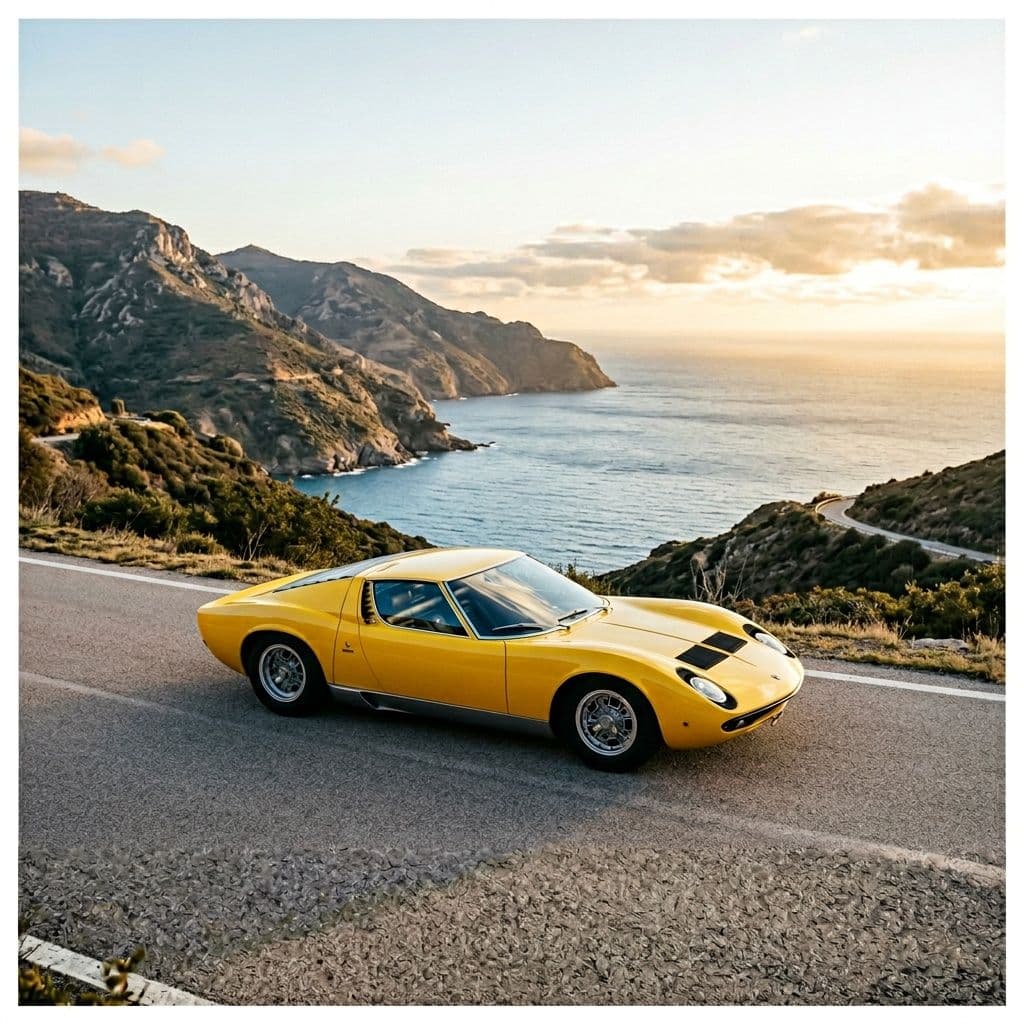
Still, this model’s mid-engine layout enabled an extremely compact 14.3-ft length, since no large front engine bay was needed, thereby establishing style and performance benefits. Stylistically, the model’s compact length fostered unique forward-leaning proportions, a short front end that naturally looked fast, a lower perceived height, and cleaner surfaces breaking from traditional GT aesthetics. From a performance standpoint, the compact length concentrated mass closer to the center, making the car quicker and more agile. The final result was a car that redefined what a road-going sports car could represent.
The Original Supercar Formula That Automakers Still Follow Today
Ferrari’s F40 is sometimes considered the original supercar, but it followed ideas that the Miura already popularized. While there had been mid-engine cars before the Miura, they were primarily for racing. Lamborghini transferred this racing ethos to the road with a two-seat car featuring a fiery engine mounted between the rear axle and the passenger compartments, a lightweight chassis, and head-turning aerodynamic bodywork. These characteristics would define the supercar exclusivity and desirability that today’s Miura investors instantly recognize.
The F40 would reflect the Miura’s philosophy with mid-engine placement, rear-wheel drive, and a low-slung body. Ferrari’s enhancements for the F40 included, but weren’t limited to, use of lightweight body materials like Kevlar and carbon fiber, and its stripped-down cabin further embodied a performance-driven mindset. The vast majority of supercars since the Miura have used a mid-engine layout for optimal weight distribution, handling, and balance. Beyond manufacturing trends, enduring collector demand reflects the Miura’s long-term significance. Enthusiasts consider the Miura P400 SV the ultimate version of this Lamborghini’s formula with its higher-powered engine, stiffened chassis, updated rear suspension, and wider rear wheels. However, the Lamborghini Miura P400 is also highly coveted, given that it’s the vehicle’s debut model.
Lamborghini Miura FAQ
Was the Lamborghini Miura the first supercar?
Have you ever asked: “Was the Lamborghini Miura the first supercar?” The answer is: sort of.
While some vehicles were referred to as supercars decades before the Lamborghini Miura P400, such as the Ensign 6 in London’s The Times 1920 story, the Miura is considered the world’s first supercar in the truest sense with its combination of racing technology, radical design, and cutting-edge performance that established a design narrative.
Why was the Miura’s mid-engine layout so important?
The Lamborghini Miura’s mid-engine layout was important because it popularized the transfer of a race-derived layout to a road car, showing how the setup’s constraints could be used to optimize a performance production vehicle rather than merely hinder it. Most supercars have since used mid-engined placement.
Lamborghini Miura vs. Ferrari F40: Did the F40 owe anything to the Miura?
Arriving more than two decades after the Miura, Ferrari’s F40 shared core characteristics with its Lamborghini counterpart beyond a mid-engine setup. These traits included, but weren’t limited to, pop-up headlights, an emphasis on mechanical purity, low-slung dramatic proportions, and boundary-pushing speed.
How Much Is a Lamborghini Miura Worth? (Average Lamborghini Miura Values)
Lamborghini Miura investment values vary based on factors like originality, mileage, condition, documentation, and story (such as notable owners). Classic.com data retrieved on June 14, 2026, indicates that the average Lamborghini Miura by May 15, 2026, sold for $3.21 million. The most valuable Lamborghini Miura is often considered to be the P400 SV. For example, the most valuable Lamborghini Miura auction saw a 1972 P400 SV go for $4.9 million through RM Sotheby’s in 2024.