
Is BMW a Good Investment? The 507, the M1, and the M Cars
Key Takeaways
- The two blue chips are the 507 and the M1. BMW built 252 507 roadsters (1956 to 1959) and 453 M1s (1978 to 1981), and both trade as verified collector assets. The 507's public record is $5.03 million (£3,809,500) for John Surtees's one-owner car at Bonhams Goodwood in July 2018, the most any BMW has made at public auction.
- That $5 million apex is the lowest top of any marque in this series, and that is the thesis, not a knock. BMW is the entry tier of the asset class, the one marque where a genuine, motorsport-homologated blue chip is reachable in the low-to-mid six figures rather than the eight.
- The standout modern classic is the E30 M3. It is a Group A homologation special, the most successful touring car of its era, and per Autofolio's analysis it edged the S&P 500 over 2015 to 2025. The rarest version, the 600-car Sport Evolution, set an E30 M3 record at about $378,000 (€325,625) at RM Sotheby's Munich in October 2025.
- The broad M-car market is enthusiast, not investment. Regular 3 Series, 5 Series, and the modern M3, M4, and M5 are built in the tens of thousands and depreciate like any performance car. The line between a BMW that compounds and one that does not runs through production volume and motorsport homologation, not the M badge.
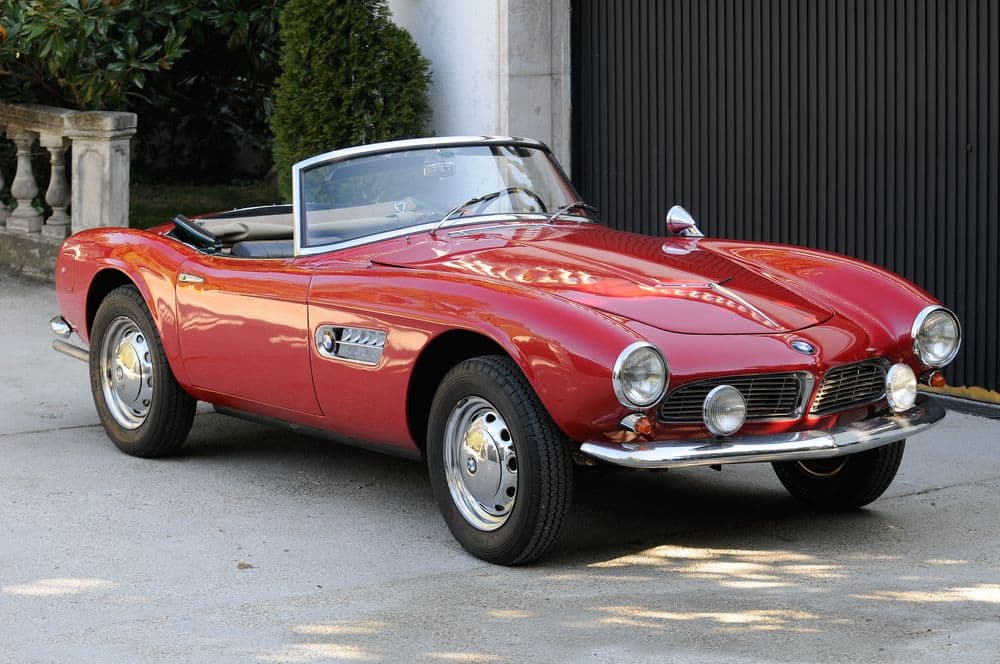
On July 13, 2018, at Bonhams' Goodwood Festival of Speed sale, a 1957 BMW 507 sold for $5.03 million (£3,809,500). It was John Surtees's car, given to him new by Count Domenico Agusta after Surtees won MV Agusta its first 500cc motorcycle world championship, and he kept it for the rest of his life. The result made it the most expensive BMW ever sold at public auction, a record it still holds.
That number is the whole question of whether BMW is a good investment, including its catch. Five million dollars is a serious result for a road car. It is also the lowest apex of any marque in this series: a Mercedes tops out near $142 million, a Ferrari at $51.7 million, even a Jaguar at $21.78 million. BMW's best is a fraction of any of them.
Read correctly, that is the reason to look at BMW, not to pass. Every other marque here builds its case from an eight-figure apex downward; BMW builds from the bottom up, on cars that went racing, were homologated in the hundreds, and can still be bought for the price of a house rather than a hedge fund. The job of this guide is to separate the few BMWs that compound from the tens of thousands that are simply very good cars.
Why BMW Is the Entry Tier of the Asset Class
Run BMW through the Autobahn Alpha Four-Factor Screen we apply to every marque on this list (production scarcity, provenance integrity, buyer-base breadth, and cultural resonance), and the pattern is clear. BMW clears provenance integrity and cultural resonance as easily as any marque here: its factory records are meticulous, BMW Group Classic still certifies the important cars, and few brands have deeper cultural reach. Where it sits below Ferrari and Porsche is on the other two factors together: production scarcity at the top is real but not extreme (252 507s, 453 M1s), and buyer-base breadth, while global, has historically paid less of a premium for a BMW than for an equivalent Italian car.
That combination is what makes BMW the entry tier. The ceiling is lower, so the blue chips cost less, and the motorsport homologation specials land at prices no other marque here can match: a Ferrari homologation special is a 250 GTO at eight figures, a BMW one is an E30 M3 at low six. Same logic, one percent of the ticket. The 507 and M1 are the genuine seven-figure blue chips at the top, and beneath them sits a deep bench of accessible, motorsport-derived cars (the 3.0 CSL, the E30 M3, and the modern M specials) where most of the money has actually been made.
The BMW 507 as an Investment: 252 Cars That Nearly Broke BMW
The 507 is BMW's pre-M blue chip. Designed by Albrecht Goertz and hand-built from 1956 to 1959 around BMW's 3.2-liter V8, it was meant to be an affordable American-market rival to the Mercedes 300 SL and failed at exactly that: it cost so much to build that BMW lost money on every example, and the program helped push the company toward the late-1950s crisis it survived only through the Quandt family's rescue. Just 252 were built, plus two prototypes. Scarcity that nearly bankrupted the maker is the best kind of provenance.
The numbers match the story. The public record is the $5.03 million (£3,809,500) paid for the Surtees car at Bonhams Goodwood in July 2018, still the most expensive BMW ever sold at auction. Ordinary but genuine examples trade well below that: a 1957 507 Series II made $2,315,000 at Bonhams' Audrain Concours sale in 2022, and Series II cars carried $2.2 million to $2.5 million estimates at Gooding and RM Sotheby's sales through 2024 and 2025, several passing when bidding fell short of reserve. The working read is a roughly $2 million to $3 million band for good cars, with genuine provenance commanding the premium.
The most famous 507 never trades: Elvis Presley's car, repainted red after fans covered the white paint in lipstick, was tracked down and restored by BMW Group Classic and now sits in the BMW Museum. It is a cultural-resonance asset the market cannot buy. For an allocator, the 507 is a legitimate blue chip (tiny production, absolute provenance, two decades of appreciation), but it is thinly traded and expensive to buy well, so it is a position to source patiently through a specialist rather than chase at auction.
The BMW M1 as an Investment: 453 Cars and the Only Mid-Engine BMW
If the 507 is BMW's pre-war-adjacent blue chip, the M1 is its supercar one, and the more interesting investment. Between 1978 and 1981 BMW built just 453 M1s, the large majority of them (around 399) road cars and the rest competition machines, atop a handful of prototypes. Styled by Giorgetto Giugiaro and built around the M88 3.5-liter straight-six that would later power the M5 and M6, it remains the only mid-engine M car ever. The project began with Lamborghini, whose finances collapsed mid-development and forced BMW to finish the car itself. Scarcity, an exotic layout, and a near-death gestation: the M1 clears provenance and cultural resonance cleanly.
The Procar Championship and the M1's Racing Keystone
The M1 carries the best motorsport story in the BMW road-car catalog. Needing to homologate the car for Group 4 racing and unwilling to wait for the category to mature, motorsport chief Jochen Neerpasch invented a series to run in the meantime. The Procar BMW M1 Championship put reigning Formula One stars in identical race-prepared M1s and ran them as a support event at European Grand Prix weekends: Niki Lauda won the inaugural 1979 title and Nelson Piquet took 1980. In parallel, an M1 Art Car painted by Andy Warhol ran the 1979 Le Mans 24 Hours and finished second in class and sixth overall. No other BMW road car has provenance like it, and that keystone is why the M1 trades where it does.
On the numbers, the M1 has quietly become a strong performer. Clean road cars trade from the low $500,000s to the mid $700,000s ($516,500 at RM Sotheby's Monterey in August 2024, $742,000 at RM Sotheby's Miami in March 2024, $604,500 at RM Sotheby's in January 2026), averaging around $612,000. The competition cars sit well above: a genuine Procar reached $1.6 million at RM Sotheby's Monterey in August 2025, the M1's public high. That spread is the M1 market in miniature, the badge setting the floor and documented motorsport provenance the ceiling. It is the clearest expression of the BMW thesis, offering 453-car exotica with a Le Mans and Formula One pedigree for less than a single ordinary Ferrari 250.
The 3.0 CSL "Batmobile": 167 Winged Cars and Where M Began
Between the seven-figure halos and the six-figure M cars sits the car that connects them, and the most historically important BMW an allocator can actually reach. The 3.0 CSL was the lightweight, homologation-special version of BMW's E9 coupe, and its winged final variant, the "Batmobile," is one of the most recognizable racing shapes of the 1970s. BMW built roughly 1,265 3.0 CSLs across all variants, but only 167 of the final 3.2-liter aerodynamic cars, the true Batmobiles: 110 in 1973 and 57 more through 1975. The huge rear wing was illegal on German roads, so the factory shipped it in the boot for the owner to bolt on afterward.
Two facts make the Batmobile matter beyond its looks. First, the racing record: the 3.0 CSL won the European Touring Car Championship six times in the 1970s (1973, then 1975 through 1979), dominating a decade of touring car racing. Second, and more important for the marque, the CSL was the first major program of BMW Motorsport GmbH, founded in 1972. The division that would build the M1, the M3, and every M car since cut its teeth on the Batmobile, and the racing stripes it wore became the M colors. Buy a 3.0 CSL and you are buying the birth of M itself.
The market has caught up. The record is about $1.10 million (€1,017,500, all-in) at RM Sotheby's Munich in November 2023, with strong European cars in the high six figures (about $419,000 / €402,500 in February 2025, about $397,000 / €368,000 in October 2024) and average-condition cars closer to $300,000. The Batmobile is the bridge in the BMW ladder: more attainable than the 507 or M1, more historic than any M3, and the cleanest way to own the motorsport pedigree that underwrites the marque.
The E30 M3 as an Investment: The Standout Modern Classic
The single best on-ramp into BMW as an asset is the E30 M3, and it rewards reading the production numbers closely. BMW built 17,970 between 1986 and 1991, which sounds like too many to be collectible. But the M3 existed to homologate BMW for Group A and DTM racing, and the rules demanded evolution specials in strictly limited numbers. Those specials, not the standard car, are where the value concentrates: 505 Evolution I cars (1987), 500 Evolution II (1988), and 600 Sport Evolution (the 2.5-liter "Evo III," 1990). Each was a genuine homologation run in the low hundreds, the same scarcity logic that underwrites a Ferrari or Porsche special at a fraction of the price.
The car has the record to justify the badge. Widely regarded as the most successful touring car of its era, with titles across the DTM and the European and British series, its dominance is the provenance keystone, and the numbers confirm the tiering. The 600-car Sport Evolution set an E30 M3 record at about $378,000 (€325,625) at RM Sotheby's Munich in October 2025; the Evolution II reached $189,500 in March 2024; standard but well-documented cars trade from roughly $60,000 to well over $100,000. The tighter the homologation number and the stronger the file, the more the car has compounded. And per Autofolio, the E30 M3 edged the S&P 500 over 2015 to 2025, a rare thing to say about what is fundamentally an enthusiast object. For a first position in this asset class it is the standout entry: investment-grade at the special-edition level, already ahead of the index over a full decade, and priced so a single manager or small syndicate can hold several.
The Future-Classic M Tier: E46 M3 CSL, E92 M3 GTS, and 1M
Below the E30 M3 sits a tier of newer M cars that are investment-grade by scarcity but not yet proven across a full cycle: the E46 M3 CSL (1,383 built, 2003 to 2004), a stripped, carbon-airboxed special trading well into six figures; the E92 M3 GTS (135 built, from a run BMW capped at 150), the rarest modern M3, with its 4.4-liter V8; and the 1M Coupe (6,309 built, 2011), already appreciated past its list price. The E39 M5 and standard E46 M3 are climbing too, but they were built in the tens of thousands and sit closer to the enthusiast conversation. This tier is a bet on the same demographic wave lifting the E30 M3, one generation younger. The E46 M3 CSL checks three of the four factors cleanly (production scarcity, motorsport-flavored significance, and a narrow buyer base by design) and is the likeliest to make the jump from future classic to established collectible. Size it as the early-cycle bet it is.
The Broad M-Car Market Is Enthusiast, Not Investment
Here is the discipline the badge tempts people to skip. The vast majority of M cars are not investments. The current M3, M4, and M5, and the regular 3 Series and 5 Series in any trim, are built in the tens of thousands, sold through dealers, and depreciate on the same curve as every other performance car: steep early, then a long used-car plateau. They are superb machines and poor stores of value, and pricing one as an investment is the most common mistake made in this marque.
The Z8 is the instructive edge case. BMW built 5,703 between 2000 and 2003, styled by Henrik Fisker as a modern homage to the 507, powered by the E39 M5's 4.9-liter V8, and famous as James Bond's car in The World Is Not Enough. It is design-significant and beloved, and it trades in a healthy $200,000 to $350,000 band. But 5,703 is not 252: the Z8 clears cultural resonance and provenance while falling short on production scarcity. It is a wonderful car and a modest, stable asset, not a compounder. That gap, between a genuinely scarce homologation special and a merely desirable limited series, is the exact line an allocator has to hold. In BMW, the M badge is not the investment thesis. Motorsport homologation and small numbers are.
Running the Carrying-Cost Math
Every car worth owning in this guide first passes the Autobahn Alpha Four-Factor Screen: production scarcity, provenance integrity, buyer-base breadth, and cultural resonance. The 507 and M1 pass on all four; the 3.0 CSL and the E30 M3 specials pass on scarcity and provenance and lean on their motorsport resonance. The second test is separate, and for BMW it matters more than for any other marque here, because BMW is the entry tier and the arithmetic gets harder as the ticket gets smaller.
A collector car has to outrun its carrying costs, meaning secure climate-controlled storage, agreed-value insurance, and specialist maintenance, before it returns a real dollar. On a $5 million 507, a generous $30,000 to $50,000 a year of upkeep is a rounding error. On a $150,000 E30 M3 Sport Evolution, the same categories run maybe $6,000 to $10,000 a year, or 4% to 7% of value, every year, before the car appreciates a dollar. That is a materially higher drag than a blue-chip Ferrari carries, and it is the honest catch of the entry tier: the lower the value, the larger the share carrying costs consume. The E30 M3 has cleared that bar over the past decade; the merely-desirable cars (the Z8, the standard M3s) barely do. At the entry tier, the wrong car does not just underperform. Its costs quietly eat the gain.
BMW vs. the Rest of the Alt-Asset Field
Against the other marques, BMW occupies one specific and revealing rung: the most accessible apex in the entire asset class.

BMW's best result sits at the bottom of the ladder, below even the Porsche Carrera GT. For a buyer chasing trophies, that is a reason to look elsewhere; for an allocator, it is the opening, because BMW is the only marque here where the pedigree, provenance, and scarcity logic that drive the whole category come without an eight-figure check. The familiar case for this asset class, that scarce, well-documented, motorsport-pedigreed cars have outrun most traditional alternatives, holds for BMW at a fraction of the capital. Knight Frank's classic-car index returned roughly 118% over the past decade (about 8% annualized) before flattening; the E30 M3 has beaten that line and, per Autofolio, edged the S&P 500 over 2015 to 2025.
What to Watch in 2026 and 2027
Whether the 507 and M1 stay thinly and firmly bid. Both are tightly held, and only a handful trade publicly each year. The M1 has shown clear strength; watch whether documented race-history cars keep pulling away from ordinary road cars, the sign of a market pricing provenance rather than the badge.
Whether the E30 M3 evolution specials keep separating from standard cars. The Sport Evolution's roughly $378,000 record and the Evolution II's $189,500 result show the homologation cars compounding while standard M3s trade in five figures. That widening gap is the healthiest signal in the BMW market and the clearest instruction: at BMW, buy the homologation number.
The demographic wave, which runs squarely in BMW's favor. Cerulli Associates projects roughly $124 trillion in wealth transfer through 2048. The buyers who grew up with E30 M3 and M1 posters are Gen X and older millennials now moving into peak earning years, so BMW's cultural resonance travels to exactly the cohort inheriting capital, the structural tailwind under the whole M-division thesis.
Whether any modern M car becomes the next E30. The E46 M3 CSL and E92 M3 GTS are the candidates, and their behavior over the next two years will show whether the future-classic tier converts. Watch for low-mileage, fully documented cars separating from ordinary examples.
Structured access reaching the entry tier. For an investor who wants exposure to a 507, an M1, or a documented E30 M3 without sourcing, storing, insuring, and authenticating it personally, fractional and SPV structures now exist, the same vehicles that bring blue-chip Ferrari and Porsche into an alternatives sleeve. BMW's lower price points make it one of the more practical marques to hold this way: a single structure can assemble a basket of scarce cars rather than one eight-figure trophy.
The BMW Thesis Is the Entry Tier Done With Discipline
BMW is the marque that makes this asset class reachable, and the one that most punishes buying on reputation instead of numbers. The 507 and M1 are genuine blue chips in the seven figures; the 3.0 CSL Batmobile is the historic bridge (167 winged cars, the birth of M) in the high six; and the E30 M3 is the standout modern classic and best on-ramp in this guide, a homologation special that has already outrun the index.
Everything beneath that is where discipline earns its keep. The broad M-car market, from the regular 3 Series to the newest M5, is enthusiast territory: superb cars, poor assets. The word "BMW," and even the letter "M," is not the investment thesis. A 507 with its file intact, an M1 with race history, a Batmobile with its wing, or a documented evolution-special E30 M3 is. Buy the cars that have already done the work, treat the rest as the driving machines they are, and BMW becomes the most accessible serious position in the whole asset class.
Frequently Asked Questions
Q: Is BMW a good investment? At the entry tier of the asset class, yes, with discipline. BMW's two blue chips, the 507 (252 built) and the M1 (453 built), are verified collector assets, and the 507's $5.03 million record (Bonhams Goodwood, 2018) is the most any BMW has made at auction. The standout modern classic is the E30 M3, a Group A homologation special that per Autofolio edged the S&P 500 over 2015 to 2025. The broad M-car market (regular 3 Series and 5 Series, and the modern M3, M4, and M5) is enthusiast, not investment. BMW is the most accessible marque in this series: the pedigree and scarcity logic that drive the whole category are reachable without an eight-figure check.
Q: Is the BMW 507 a good investment? It is a legitimate blue chip. Only 252 were built between 1956 and 1959, and they were so costly to hand-build that the program helped push BMW toward its late-1950s financial crisis. The public record is $5.03 million (£3,809,500) for John Surtees's one-owner car at Bonhams Goodwood in July 2018, still the most expensive BMW ever sold at auction, while good Series II examples trade in a roughly $2 million to $3 million band. It is thinly traded and expensive to buy well, so it is a position to source patiently through a specialist rather than chase at auction.
Q: Is the BMW M1 a good investment? It is BMW's most compelling blue chip and the more accessible of the two. BMW built just 453 M1s (1978 to 1981), and it remains the only mid-engine M car ever, with a Formula One-adjacent Procar pedigree (Lauda won the 1979 title, Piquet the 1980) and an Andy Warhol Art Car that ran Le Mans in 1979. Road cars trade from the low $500,000s to the mid $700,000s (a 1981 car made $742,000 at RM Sotheby's Miami in March 2024), and a genuine Procar reached $1.6 million at RM Sotheby's Monterey in August 2025. It offers motorsport-grade scarcity for less than a single ordinary Ferrari 250.
Q: Is the BMW E30 M3 a good investment? It is the standout modern classic in the marque and the best entry point in this guide. BMW built 17,970, but the value concentrates in the homologation specials: Evolution I (505), Evolution II (500), and the 2.5-liter Sport Evolution (600). The E30 M3 is widely regarded as the most successful touring car of its era, and per Autofolio it edged the S&P 500 over 2015 to 2025. The Sport Evolution set an E30 M3 record at about $378,000 (€325,625) at RM Sotheby's Munich in October 2025, while standard documented cars trade from roughly $60,000 to over $100,000. The tighter the homologation number and the better the documentation, the more the car has compounded.
Q: What is the most expensive BMW ever sold? John Surtees's 1957 BMW 507, which sold for $5.03 million (£3,809,500) at Bonhams' Goodwood Festival of Speed sale in July 2018. Surtees owned it from new, a gift from Count Agusta for winning MV Agusta its first 500cc motorcycle world championship, and kept it for the rest of his life. That single-ownership provenance is why it commanded roughly double the price of an ordinary 507. Notably, the most culturally famous 507, the one Elvis Presley owned, is not for sale: BMW restored it and placed it in the BMW Museum.
Q: How do I invest in a BMW without buying one outright? Fractional and SPV-structured ownership platforms now offer accredited investors exposure to investment-grade cars such as a 507, an M1, or a documented E30 M3 evolution special, without sourcing, storing, insuring, and authenticating the car personally, the same structures that bring blue-chip Ferrari and Porsche into an alternatives sleeve. BMW's lower price points make it one of the more practical marques to hold this way, because a single structure can assemble a small basket of scarce cars rather than a lone eight-figure trophy. Diligence on fees, exit timing, and provenance verification still varies by manager.

Joseph Chappius — Automotive Journalist
Fifteen years in wealth management. Now writing about collector cars, alternative assets, and the stories behind them. All articles →
-800x530.jpg&w=3840&q=75&dpl=dpl_DQiTLd73E64SRjzekpXdHoPoCuaA)