Is Jaguar a Good Investment? D-Types, E-Types, and the British Icon
Key Takeaways
- On August 19, 2016, a 1955 Jaguar D-Type sold for $21.78 million at RM Sotheby's Monterey, the most any Jaguar has ever brought at public auction. It was chassis XKD 501, the Ecurie Ecosse car that won the 1956 Le Mans 24 Hours, and the result made it the most expensive British car ever sold at the time, a record it held until an Aston Martin DBR1 passed it a year later.
- That one-year-apart finish is the whole Jaguar thesis in miniature. Jaguar's blue chips trade in the same tier as Aston Martin's and sell for slightly less. Jaguar has the narrowest global buyer base of the blue-chip marques, and that is exactly why it trades at a discount to Aston Martin and offers the strongest value case on this list for patient capital.
- The competition cars and the Lightweight E-Type are verified blue chips. The C-Type, D-Type, and XKSS trade at high seven and eight figures, and the 12 Lightweight E-Types sit in the same conversation as any Tier 1 Ferrari. The standard Series 1 E-Type is a different animal: a genuinely appreciating enthusiast car, but not a blue chip.
- The XJ220 is the compounding modern halo, up sharply from two decades of neglect. Below it, the vast run of ordinary E-Types, saloons, XKs, and modern Jaguars are enthusiast cars and poor stores of value. The line between a Jaguar that compounds and one that does not runs through production scarcity and racing pedigree, not the badge.
On August 19, 2016, at RM Sotheby's Monterey sale, a 1955 Jaguar D-Type sold for $21.78 million. It was chassis XKD 501, delivered new to the Scottish privateer team Ecurie Ecosse and driven by Ron Flockhart and Ninian Sanderson to victory at the 1956 Le Mans 24 Hours. Four collectors fought over it for fifteen minutes. The result made it the most expensive Jaguar ever sold at public auction, and the most expensive British car of any make at the time, comfortably past the $14.3 million an Aston Martin DB4 GT Zagato had set as the prior British record.
Then, one year later, an Aston Martin DBR1 sold for $22.55 million at the same auction house's Monterey sale, and took the British crown back by three-quarters of a million dollars.
That one-year, three-quarter-million-dollar gap is the Jaguar investment case in a single data point. Jaguar's best cars trade in the same blue-chip tier as Aston Martin's best cars, and they trade for slightly less. The reason is not quality, provenance, or racing record, where Jaguar gives up nothing. The reason is the buyer base, and understanding that discount is the whole job of this guide.
Why Jaguar Is the Blue Chip at a Discount
Run Jaguar through the Autobahn Alpha Four-Factor Screen we apply to every marque on this list (production scarcity, provenance integrity, buyer-base breadth, and cultural resonance), and it scores at or near the top on three of the four. Production scarcity is brutal at the top: 87 D-Types, 53 C-Types, 16 XKSS, 12 Lightweight E-Types. Provenance integrity is absolute, with factory build records, Jaguar Daimler Heritage Trust certificates, and unbroken chassis histories on the important cars. Cultural resonance is as deep as any marque here: Enzo Ferrari reportedly called the E-Type the most beautiful car ever made, and the D-Type won Le Mans three years running.
The one factor where Jaguar trails is buyer-base breadth. A blue-chip Ferrari or Porsche draws bids from eighty countries; Jaguar's top cars pull from a narrower, more British and American pool. That single gap is the entire discount. It is why a D-Type with a Le Mans win sells for less than an Aston Martin DBR1 with a comparable one, and for a fraction of a Ferrari 250 GTO with a similar race record.
For an allocator, a narrow buyer base is a risk and an opportunity in the same sentence. It means thinner demand and slightly softer liquidity in a downturn. It also means the cars are structurally cheaper than their pedigree warrants, and the thing that would close the discount, a broadening global bid, is exactly what the wealth-transfer decade ahead is set up to deliver. Jaguar is the value tier of the blue-chip conversation, and value is only value if you can tolerate the reason it is cheap.
The Jaguar D-Type as an Investment: 87 Cars and a Le Mans Hat-Trick
The D-Type is Jaguar's apex, and one of the great racing cars of any marque. Built from 1954 to 1957 around a monocoque center section and Malcolm Sayer's aerodynamic body, it was engineered for Le Mans and it delivered: D-Types won the 24 Hours three consecutive years, in 1955, 1956, and 1957, the last of those an Ecurie Ecosse one-two with five of the top six finishers wearing the shape. Jaguar built 87 in total, a figure that bundles works cars, customer competition cars, and the road-going XKSS conversions. Estimates of survivors cluster around 71, with the manufacturer total and the registry-confirmed survivor count differing by a handful depending on how wrecked and rebuilt cars are counted.
The $21.78 million paid for XKD 501 in 2016 is the number that anchors the marque, and it was a specific car: a genuine works-supported privateer entry with an outright Le Mans win in its history. That is the ceiling. Ordinary customer D-Types without a marquee race result trade lower, in the high seven figures to low eight, but even there the scarcity and the shared Le Mans pedigree hold the floor up. The D-Type clears every test the screen sets, and it is the one Jaguar an allocator can point to and say the blue-chip thesis has already worked across multiple cycles.
The C-Type and XKSS: The Rest of the Competition Blue Chips
The provenance keystone under the whole marque is not one car but a five-year run of Le Mans wins. Between the C-Type and the D-Type, Jaguar won the 24 Hours five times in seven years: the C-Type in 1951 and again in 1953 (the 1953 win came at over 100 mph average, on the first disc brakes ever raced at Le Mans), then the D-Type in 1955, 1956, and 1957. No British marque has a denser competition record from the era, and it is why the whole Jaguar top tier carries the value it does.
The C-Type (53 built, 1951 to 1953) is the earlier blue chip. A 1953 Works Lightweight, chassis XKC 052, set the model record at $13.2 million at RM Sotheby's Monterey in 2015. The XKSS is the rarest of all: a road-legal conversion of leftover D-Type racing chassis, of which just 16 were completed before the February 1957 fire at Jaguar's Browns Lane factory destroyed nine more on the line. A 1957 XKSS sold for $13,205,000 at RM Sotheby's Monterey in 2023. The most famous of the 16, Steve McQueen's green car, chassis 713, sits in the Petersen Automotive Museum and is valued privately well above any public result. For an allocator, the C-Type and XKSS are real blue chips but supply rounds to almost nothing; their role is to explain why the D-Type carries its premium.
The Lightweight E-Type: 12 Cars in the Tier 1 Conversation
The E-Type that belongs in the blue-chip tier is not the one in most collections. It is the Lightweight, a competition version built with an aluminum monocoque and an alloy engine block for privateer racing. Jaguar allocated 18 chassis numbers and completed 12 cars in 1963 and 1964; the manufacturer-versus-registry gap here is real and worth naming, because the marque later built 6 continuation cars in 2014 and 2015 to complete the originally intended run of 18, and those continuations trade as a separate, lower category from the 12 originals. A pair of the originals were rebodied with low-drag coupe coachwork, and the count of true low-drag cars is itself contested.
The originals are Tier 1 cars. An ex-Team Cunningham Lightweight, raced at the 1963 Le Mans by Walt Hansgen and Augie Pabst, sold for roughly $8 million at Bonhams' Quail Lodge sale in 2017, and clean original Lightweights have traded in a broad $7 million to $8 million-plus band. At those numbers, a Lightweight E-Type sits in the same blue-chip conversation as any Tier 1 Ferrari, on twelve cars, an alloy monocoque, and a period racing record. It is the E-Type an allocator underwrites as an asset. Everything else wearing the E-Type badge is a different investment question.
The Series 1 E-Type as an Investment: Appreciating, Not Blue Chip
This is where the marque tempts people to skip the discipline. The standard Series 1 E-Type is one of the most beautiful and beloved cars ever built, and it is an appreciating enthusiast car. It is not a blue chip, and pricing it as one is the most common error made in this marque.
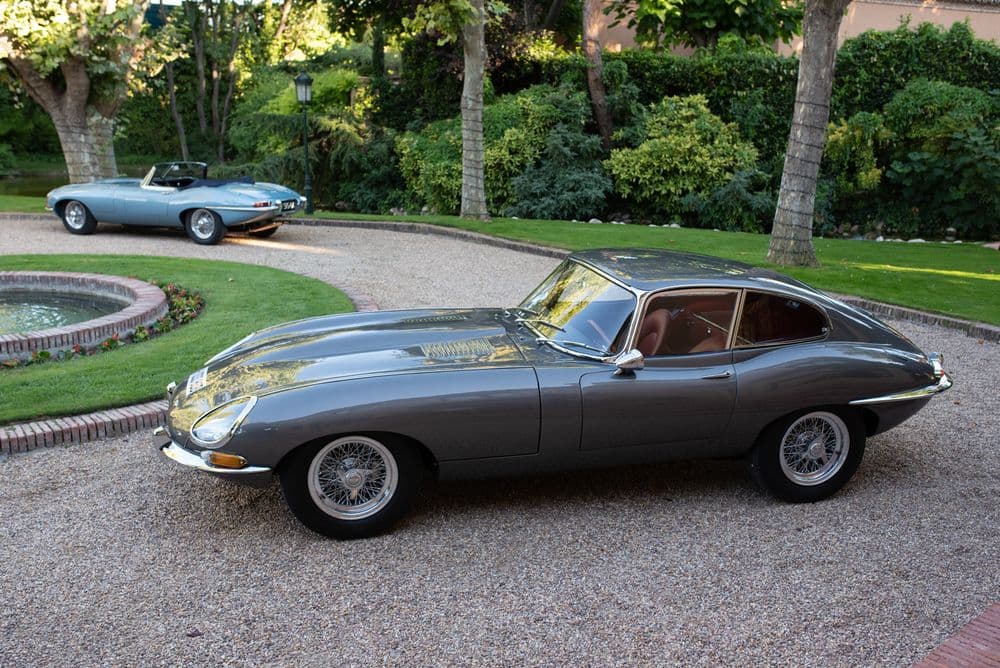
The design-era cars are the Series 1 3.8-liter (1961 to 1964) and the Series 1 4.2-liter (1964 to 1968), and within them the earliest cars carry the premium: the flat-floor 3.8 roadsters, and above all the first right-hand-drive cars with external bonnet locks, are the most collectible standard E-Types. A landmark early 1961 roadster set a standard-car record around $1.14 million, and exceptional flat-floor cars have reached the low seven figures. But those are outliers. Good, honest Series 1 roadsters trade in a roughly $150,000 to $300,000 band, and the market has been broadly flat to modestly up for several years, not compounding. The reason is production: Jaguar built more than 70,000 E-Types across all series, and a car made in the tens of thousands can be a wonderful thing to own and still fail the scarcity factor outright. The Series 1 is the most-cited Tier 2 entry in the Jaguar catalog, a car you buy to drive and enjoy, not a position that clears a carrying-cost spreadsheet.
The Modern Halo: The XJ220 and the F-Type Project 7
Jaguar's compounding modern halo is the XJ220. Built from 1992 to 1994, it was the fastest production car in the world at launch, at 217 mph, and it spent two decades as a punchline instead of an asset: buyers who had put deposits on a promised V12, all-wheel-drive supercar balked when the production car arrived with a twin-turbo V6 and rear-wheel drive, and many walked from their deposits into a recession. Jaguar built 281 (some sources cite 282), well short of the roughly 350 originally planned. That story is exactly why the XJ220 was cheap for so long, and why it has climbed. Values now sit in a roughly $450,000 to $700,000 band, with a median near $475,000; a 1994 car reached about $687,000 at RM Sotheby's Monterey in 2023, and a strong example made $527,500 at Broad Arrow Amelia Island in March 2024. The market is discriminating: ambitious $700,000-plus estimates have passed unsold at 2025 sales, which is the healthy sign of a market pricing condition and provenance rather than the badge.
The F-Type Project 7 is the cautionary counterpoint. A limited run of 250 cars (2015 to 2016), styled as a modern D-Type homage and listed near $166,000 ($135,000 in the UK), it has not made the leap the XJ220 did. It trades around its original list, in a roughly $105,000 to $330,000 range with an average near sticker, and Hagerty has specifically noted that its rarity has not translated into added value. Scarcity alone is not a thesis: the Project 7 is scarce and has not compounded, while the XJ220 is scarce, historically significant as a former record-holder, and has. That contrast is the whole modern-Jaguar lesson.
The Jaguars That Do Not Compound
The vast majority of Jaguars are not investments. The volume E-Types (later Series 2 and Series 3 cars, the automatic 2+2s, the V12s), the XK120/140/150 touring cars outside the rarest specifications, the Mark 2 and XJ saloons, the XJS, and the entire modern range from the XK8 to the F-Pace are built in the thousands or tens of thousands, and they depreciate or drift sideways like any other used car once carrying costs are counted. Some are appreciating gently on nostalgia, but none compound at a rate that clears their drag, whatever a retail seller labels them.
The instructive edge case is the E-Type itself, because the badge spans the whole spectrum: a Lightweight is a genuine eight-figure-adjacent blue chip, a good Series 1 3.8 roadster a low-six-figure appreciating enthusiast car, a tired Series 3 V12 2+2 a project. Same three letters, three asset classes, and that range inside one model is the discipline an allocator has to hold. In Jaguar, the leaping-cat badge is not the investment thesis. Racing pedigree and tiny production are.
Running the Carrying-Cost Math
Every car worth owning in this guide first passes the Autobahn Alpha Four-Factor Screen: production scarcity, provenance integrity, buyer-base breadth, and cultural resonance. The D-Type, C-Type, XKSS, and Lightweight E-Type pass on all four, with the buyer-base factor the only soft spot and the source of the marque's discount. The standard E-Type fails production scarcity outright. The second test is separate, and it is pure arithmetic.
A collector car has to outrun its carrying costs, meaning secure climate-controlled storage, agreed-value insurance, and specialist maintenance, before it returns a real dollar. On a $21 million D-Type, even $40,000 a year of upkeep is a rounding error against the asset. On a $200,000 Series 1 roadster, the same categories run maybe $6,000 to $10,000 a year, or 3% to 5% of value, every year, before the car appreciates a dollar, and a car drifting sideways in value does not clear that. This is the honest center of the Jaguar case. The screen and the math agree at the top: the competition cars and the Lightweight have compounded past their costs by wide margins across cycles. They agree at the bottom too: the standard cars mostly have not. The discount that makes Jaguar attractive lives in the blue-chip tier, not in the enthusiast tier where the badge is easiest to buy.
Jaguar vs. the Rest of the Alt-Asset Field
Against the other blue-chip marques, Jaguar occupies a specific and telling rung: the value seat at the same table.

The table makes the discount literal. The Jaguar D-Type sits one line below the Aston Martin DBR1, separated by less than a million dollars: two 1950s British Le Mans cars in the same tier, Jaguar priced just under. Both sit far below the Ferrari and Mercedes apex despite comparable racing pedigree, the buyer-base discount stated in dollars for the whole British category, carried a little more heavily by Jaguar than by Aston.
The familiar case for this asset class, that scarce, well-documented, racing-pedigreed cars have outrun most traditional alternatives, holds for Jaguar with a value tilt. Knight Frank's classic-car index returned roughly 118% over the past decade (about 8% annualized) before flattening toward 1%. Jaguar's blue chips have tracked or beaten that line while sitting at a structurally lower entry point than the Aston Martin equivalents, which is the definition of a value case: the same asset quality for a lower multiple, because the buyer pool is thinner.
What to Watch in 2026 and 2027
Whether the buyer-base discount narrows. The whole thesis is that the cars are cheap relative to their pedigree because the bid is narrow. Watch whether Gulf and Asian buyers, who already chase Ferrari and Mercedes, start pulling D-Types and Lightweights toward Aston Martin money. Any sign of the discount closing is the most important signal in the marque.
Whether the Series 1 E-Type stays flat or turns. The standard E-Type has been broadly flat for years. It is the most beloved shape in the catalog and the one most exposed to a broadening enthusiast base, so watch whether flat-floor and outside-lock cars begin separating decisively from ordinary examples. That separation would be the first sign the market is pricing the early cars as assets rather than pretty drivers.
Whether the XJ220 holds its re-rating. The XJ220 has climbed out of two decades of neglect. Watch whether documented, low-mileage cars keep pulling away from ordinary ones, or whether the unsold high estimates at 2025 sales mark a ceiling for now.
Generational rotation runs in Jaguar's favor. Cerulli Associates projects roughly $124 trillion in wealth transfer through 2048. The E-Type and D-Type are among the most culturally durable shapes in the collector world, and the cohort now inheriting capital grew up with them as icons. A wider, younger, more global buyer base is precisely the force that would close Jaguar's discount to Aston Martin.
Structured access reaches the British blue chips. For an investor who wants exposure to a D-Type, an XKSS, or a Lightweight E-Type without sourcing, storing, insuring, and authenticating the car personally, fractional and SPV structures now exist, the same vehicles that bring blue-chip Ferrari and Porsche into an alternatives sleeve. Jaguar's discount makes it one of the more efficient marques to hold this way, because the entry price for a genuine Le Mans-pedigreed blue chip is lower than any comparable Ferrari or Aston.
The Jaguar Thesis Is Britain's Blue Chip at a Discount
Jaguar is the marque where the pedigree is unimpeachable and the price is not what the pedigree would command anywhere else. The competition cars are peerless: five Le Mans wins in seven years, 87 D-Types, 53 C-Types, 16 XKSS, and a D-Type auction record that briefly made it the most valuable British car on Earth. The Lightweight E-Type puts a genuine Tier 1 car in the same conversation as any Tier 1 Ferrari, on twelve examples. If you can reach those cars, outright or through a structure, you are buying a blue chip at a discount to its Aston Martin equivalent, and the reason for the discount is the one thing the decade ahead is most likely to change.
Everything beneath that is where discipline earns its keep. The standard Series 1 E-Type is a beautiful, appreciating enthusiast car and not a blue chip. The XJ220 is the one modern halo that has compounded; the Project 7 is the reminder that scarcity alone does not. The mass-market E-Types, saloons, and modern cars are cars. The word "Jaguar" is not the investment thesis. A D-Type with its Le Mans file, an XKSS, or an original Lightweight is, and it costs less than the badge on either side of it deserves. Buy the cars that have already done the work, treat the discount as the opportunity it is, and Jaguar becomes the strongest value position in the whole blue-chip field.
Frequently Asked Questions
Q: Is Jaguar a good investment? At the top tier, yes, and at a discount to its rivals. Jaguar's competition cars (the C-Type, D-Type, and XKSS) and the 12 Lightweight E-Types are verified blue chips, and a 1955 D-Type sold for $21.78 million at RM Sotheby's Monterey in 2016, the most any Jaguar has made at auction. Those cars trade in the same tier as Aston Martin's best and sell for slightly less, because Jaguar has the narrowest global buyer base of the blue-chip marques. The standard Series 1 E-Type is an appreciating enthusiast car, not a blue chip, and the mass-market Jaguars are not investments. Jaguar is the value case of this series: the same pedigree for a lower multiple.
Q: Is the Jaguar D-Type a good investment? It is Jaguar's blue-chip apex. Jaguar built 87 D-Types from 1954 to 1957, with roughly 71 thought to survive, and D-Types won Le Mans three years running (1955, 1956, and 1957). The record is $21.78 million for chassis XKD 501, the Ecurie Ecosse 1956 Le Mans winner, at RM Sotheby's Monterey in 2016, which briefly made it the most expensive British car ever sold. Ordinary customer cars trade lower, in the high seven to low eight figures, but supply is tiny and the pedigree permanent, which is why the D-Type has compounded across cycles.
Q: Is the Jaguar E-Type a good investment? It depends entirely on which E-Type. The 12 Lightweight E-Types (1963 to 1964) are Tier 1 blue chips: an ex-Cunningham car sold for roughly $8 million at Bonhams Quail Lodge in 2017. The standard Series 1 3.8 and 4.2 cars are a different question. They are appreciating enthusiast cars, with good roadsters trading in a roughly $150,000 to $300,000 band and the earliest flat-floor cars higher, but Jaguar built more than 70,000 E-Types, so they fail the scarcity test a blue chip has to pass. Buy a standard E-Type to drive; buy a Lightweight as an asset.
Q: What is the most expensive Jaguar ever sold? A 1955 Jaguar D-Type, chassis XKD 501, which sold for $21.78 million at RM Sotheby's Monterey in August 2016. It was the Ecurie Ecosse car that won the 1956 Le Mans 24 Hours, and the price made it the most expensive British car of any make at the time, topping the $14.3 million record for an Aston Martin DB4 GT Zagato. An Aston Martin DBR1 reclaimed the British record at $22.55 million a year later, which is why Jaguar's apex sits just below Aston's.
Q: Is the Jaguar XJ220 a good investment? It is the marque's compounding modern halo. Built from 1992 to 1994, the XJ220 was the fastest production car in the world at launch (217 mph), but it spent two decades cheap after buyers balked at its twin-turbo V6 and walked from deposits into a recession. Jaguar built 281. Values have since climbed to a roughly $450,000 to $700,000 band, with a 1994 car reaching about $687,000 at RM Sotheby's Monterey in 2023. The market rewards documented, low-mileage cars and has passed on ambitious estimates, the sign of a market pricing the car as an asset rather than the badge.
Q: How do I invest in a Jaguar without buying one outright? Fractional and SPV-structured ownership platforms now offer accredited investors exposure to investment-grade cars such as a D-Type, an XKSS, or a Lightweight E-Type, without sourcing, storing, insuring, and authenticating the car personally, the same structures that bring blue-chip Ferrari and Porsche into an alternatives sleeve. Jaguar's discount to its rivals makes it one of the more efficient marques to hold this way, because a genuine Le Mans-pedigreed blue chip costs less here than any comparable Ferrari or Aston. Diligence on fees, exit timing, and provenance still varies by manager.

Joseph Chappius — Automotive Journalist
Fifteen years in wealth management. Now writing about collector cars, alternative assets, and the stories behind them. All articles →
-800x530.jpg&w=3840&q=75&dpl=dpl_DQiTLd73E64SRjzekpXdHoPoCuaA)