What Happens to Collector Car Prices When Interest Rates Fall?
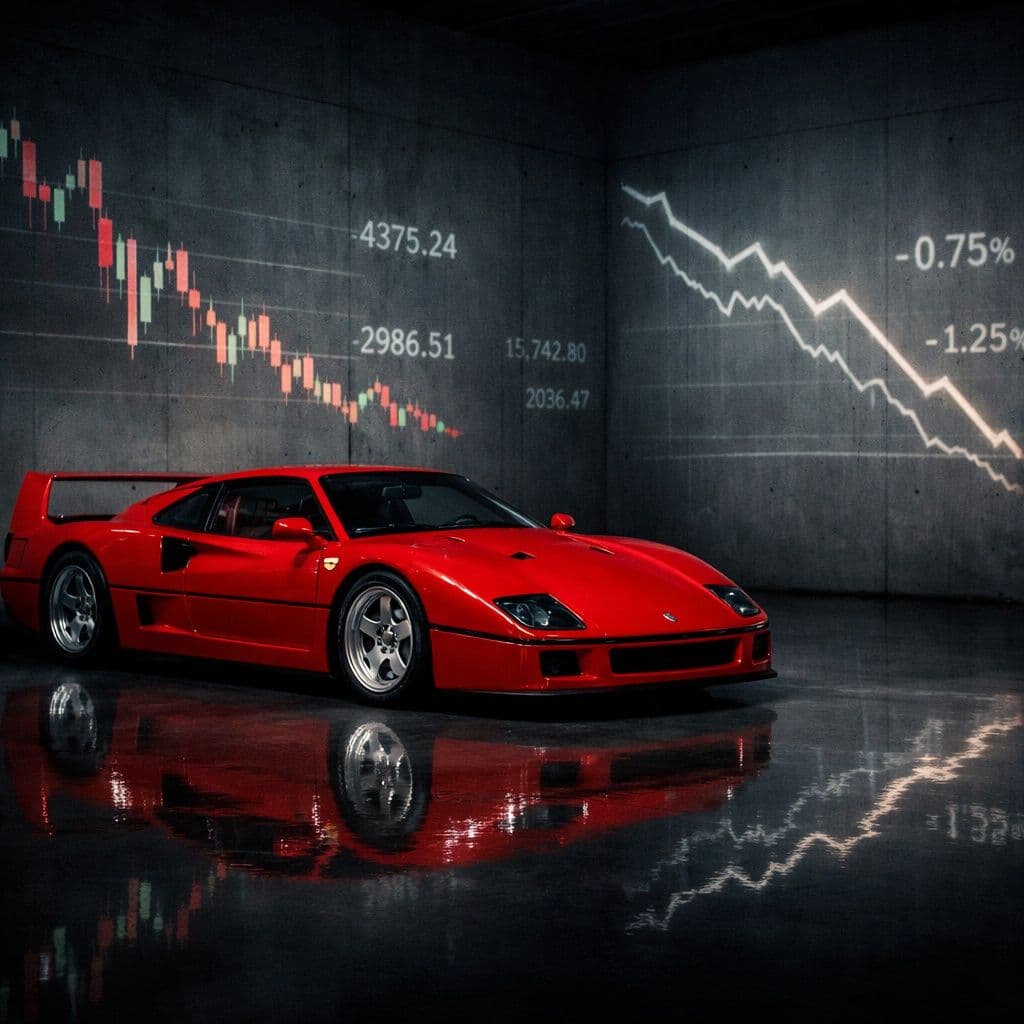
Short answer. Falling rates lift collector car prices, but unevenly. Top-tier blue chips and financed
mid-tier exotics ($250,000 to $1 million) move most. Mass-market segments are dominated by
supply overhang and demographic transition, not the funds rate.
Between September 2024 and December 2025, the Federal Reserve cut its policy rate by approximately 175 basis points, from a 5.25 to 5.50% target range down to the 3.50 to 3.75% range where it has remained as of May 2026.
If collector car prices behaved the way a textbook says they should under falling rates, the entire market would be ripping. Cheap money, lower discount rates, and capital flowing out of bonds into real assets is supposed to be jet fuel for tangible alternatives.
What actually happened is more interesting. Top-tier auction results have been spectacular: RM Sotheby's posted its best year ever in 2025 at over $1 billion (per RM Sotheby's year-end results), and Q1 2026 dollar volume is up 31% year over year (per CLASSIC.COM's Q1 2026 market data). Meanwhile, the Hagerty Market Rating ticked up to 59.01 in April 2026 but remains in flat-market territory, well below its June 2022 peak, and mass-market collectibles are still 15 to 30% below their 2022 peaks.
One asset class. One rate cycle. Two completely different responses. The story of what happens to collector car prices when rates fall is really a story about which collector cars, and why.
How Does Fed Policy Reach Collector Car Prices? The Three Channels
Three paths: cheaper leverage for financed buyers, the discount-rate effect on long-duration assets, and the risk-on rotation out of bonds into real assets.
Falling rates don't push collector car prices up by some kind of macro osmosis. They work through three identifiable channels.
1. The Cost of Leverage
A meaningful slice of the collector market runs on credit. Specialty lenders like JJ Best Banc, Woodside Credit, and Putnam Leasing finance cars across the collector market, from modest entry-level classics into the seven figure range, and high-net-worth buyers regularly use securities-backed lines of credit to fund purchases without liquidating equity positions. When the Fed cuts, the all-in cost of those borrowings drops directly. A buyer financing a $500,000 car at 8% versus 10% saves roughly $10,000 a year in carry. That changes how aggressively that buyer bids.
2. The Discount-Rate Effect on Long-Duration Assets
Collector cars are a long-duration asset whether or not anyone calls them that. The expected payoff is years out. Lower rates raise the present value of any future cash flow or terminal sale price, and that revaluation is mechanical. It happens in equities the same week the Fed acts. In illiquid markets like collector cars, the same effect plays out, just slower and unevenly.
3. The Risk-On Rotation
The third channel is the most powerful and the hardest to model. When bond yields fall, capital looks elsewhere for return. Some of that flow lands in equities. Some lands in real estate. A small but visible slice lands in the alternatives bucket: art, wine, watches, and yes, collector cars. The 2009 to 2021 era of zero-bound rates produced the largest sustained collector car bull market on record, and that was not a coincidence.
These three channels usually point the same direction during a cutting cycle. The complication is that they don't all reach the same cars equally, which is exactly what 2024 to 2026 has demonstrated.
How Have Collector Car Prices Reacted to Past Rate Cycles? Four Cycles, Four Different Reactions
The 2008 to 2010 cuts seeded a decade-long bull run. The 2020 cuts triggered an immediate boom. The 2022 to 2024 hikes punished mass-market cars but spared the top. The 2024 to 2026 cuts so far have only lifted the blue chips.
2008 to 2010: Emergency Cuts and the Decade-Long Bull Run
The Fed cut its policy rate from a 5.25% peak (held since June 2006) to effectively 0% between September 2007 and December 2008. Collector car prices initially declined alongside everything else in 2009, but the Hagerty Blue Chip Index recovered faster than the S&P 500 and went on to post one of the strongest decade-long runs in the asset class's history. Knight Frank's Luxury Investment Index shows luxury collectibles, including cars, compounding through that entire zero-rate era.
This is the cleanest historical case of falling rates lifting the whole collector car market. The catch: the cut was paired with a once-in-a-generation crisis that compressed valuations across asset classes first, and the recovery took years to fully materialize.
2020: Emergency Cuts and the COVID Boom
The Fed cut to zero in March 2020. Within twelve months, the collector car market entered the most dramatic rally in its history. Bring a Trailer's annual dollar volume grew roughly fivefold between 2019 and 2022 (approximately $280M in 2019 to ~$1.36B in 2022), per BaT's published year-end recaps and Hagerty Insider's BaT volume analyses. The Hagerty Market Rating posted gains in 21 of 29 months from January 2020 through its all-time high in June 2022. Cars purchased in 2020 and resold in 2021 delivered a median return of 18.7%, per Hagerty Insider's post-pandemic price analysis.
That episode looked like a textbook rate-cut response, but it wasn't only rates. Lockdowns shifted attention toward tangible assets, stimulus injected liquidity, and digital platforms removed geographic friction at exactly the right moment. Rates were a contributing channel, not the sole driver.
2022 to 2024: The Hike Cycle and the Mass-Market Correction
This is the cleanest negative case. The Fed raised rates from 0 to 0.25% in March 2022 to 5.25 to 5.50% by mid 2023, the fastest tightening cycle in four decades. The collector car market peaked in June 2022 and rolled over almost in lockstep. The Hagerty Market Rating declined in the majority of months that followed. Mass-market collectibles gave back 15 to 30%. Pandemic-era speculative favorites like the second-generation Dodge Viper shed 8 to 10%.
Top-tier cars held up notably better. The Schumacher Ferrari F2001 sold for approximately $18 million in 2025, more than double its 2017 result. Knight Frank's classic car component still posted a positive 1.2% return in 2024 even as the broader luxury index dropped 3.3%. The hike cycle proved that rates matter, but it also proved that not every car has the same rate sensitivity.
2024 to 2026: Cuts Without a Broad Recovery
This is the cycle in progress. The Fed cut three times in late 2024 and three more times in 2025, taking the policy rate from 5.25 to 5.50% down to 3.50 to 3.75%. By the textbook, all three transmission channels should now be running in the market's favor.
What actually happened is bifurcated. The top of the market is at records: RM Sotheby's Monaco sale on April 25, 2026 reached €87.97 million, the highest-grossing collector car auction ever held in Europe, led by a 1961 Ferrari 250 GT SWB California Spider at €16.66 million (a model world record). Q1 2026 dollar volume is up 31% year over year (per CLASSIC.COM's Q1 2026 market data). Meanwhile, the Hagerty Market Rating, at 59.01 in April 2026, remains in flat-market territory and well below its 2022 peak, and global average values fell roughly 10% in 2025 according to The Classic Valuer's market review.
The cuts lifted the boats that were already buoyant. They didn't lift the ones that were taking on water.
Why Haven't the 2024 to 2026 Cuts Lifted the Whole Market?
Three forces are pulling against the rate effect: a supply surge from online platforms, a post-
COVID speculative cohort that exited, and a demographic shift away from boomer-era cars no
Fed pivot can reverse.
Supply. Online platforms made it easier than ever to consign a car, and the volume coming to market in 2025 grew about 9.7% even as prices declined. Cheap money helps demand; it can't absorb a supply surge in the mass-market segment.
Speculative exits. A meaningful chunk of the 2020 to 2022 buyer base was speculative. That cohort exited as carrying costs ate into modest cars, and lower rates haven't brought them back. They were never long-term collectors.
Demographic shift. Boomer-era cars are softening as that cohort ages out, regardless of where the funds rate sits. No Fed pivot rescues a car a younger generation doesn't want.
Meanwhile, the strongest parts of the market remain concentrated around culturally significant cars with genuine scarcity and emotional staying power — particularly the final generation of analog-era supercars.
Which Collector Cars Move Most With Rates? The Rate-Beta Map
Mid-tier exotic and high-end collectibles ($250,000 to $1 million) carry the highest rate sensitivity because their buyers most often finance. Investment-grade blue chips ($1 million+) are the least sensitive: cash buyers, global demand, scarcity-driven pricing.
Not every collector car has the same sensitivity to monetary policy.

The investment-grade tier is the least rate-sensitive paradoxically because its buyers are the least financially constrained. A buyer writing a wire for a Ferrari 250 GTO doesn't change behavior based on a 25-basis-point cut. The mid-tier exotic and high-end collectible space is where rate cuts move the needle most directly: those buyers run real spreadsheets, and a few hundred basis points of carry change the math.
What Are the Risks If Rates Stay Low for Longer?
Persistent low rates attract speculative capital into segments that don't belong in the asset class.
The 1980s Ferrari bubble (~900% in five years, then a ~75% crash) is the canonical case; 2020 to
2022 mid-tier was a smaller rhyme.
In the 1980s, Japanese real estate wealth fueled by ultra-loose monetary conditions pushed Ferrari values up roughly 900% in five years before the Nikkei crashed in 1990 and the Daytona market collapsed by roughly 75%. The 2020 to 2022 episode rhymed at smaller scale: speculative buyers piled into mid-tier collectibles, then exited as rates rose and carrying costs bit.
If rates stay at or below 3.75% for an extended period, the risk isn't that the market won't go up. It's that the wrong cars will, and the same dynamic that punished mass-market collectibles in 2022 to 2024 plays out again when the next reversal arrives.
Bottom Line
Don't buy a car because rates are falling. Buy a car because it has verifiable scarcity, airtight provenance, and a global buyer base. Falling rates make those cars more expensive at the margin; they do not turn marginal cars into investments.
That is the practical takeaway, and the 2024 to 2026 cycle proves it. The lift from falling rates is real but uneven, and increasingly concentrated in the segment that needs it least: the top of the market is breaking records, the financed mid-tier is firmer than it was, and the mass-market segment is still working through a supply overhang and a demographic transition that monetary policy can't fix.
Frequently Asked Questions
Q: Do collector car prices always go up when interest rates fall?
No. The 2008 to 2009 cuts produced an initial decline before a multi-year recovery. The 2020 cuts produced an immediate boom. The 2024 to 2025 cuts have produced a bifurcated response: top-tier records alongside continued mass-market weakness. Rates are one of three or four major drivers, not the only one.
Q: How much have rates fallen in the current cycle?
The Fed cut its policy rate from a 5.25 to 5.50% target range to a 3.50 to 3.75% range between September 2024 and December 2025, a roughly 175-basis-point decline. The Fed has held rates steady through the first three meetings of 2026 amid persistent inflation concerns.
Q: Which collector cars benefit most from lower rates?
The high-end exotic and mid-tier collectible segments, roughly $250,000 to $1 million, where buyers most often use financing. Lower rates directly reduce the cost of carry and increase what those buyers can bid. Investment-grade cars above $1 million benefit less directly because their buyers are typically less rate-sensitive.
Q: Why is the broad collector car market still soft if rates have fallen?
The Hagerty Market Rating, at 59.01 in April 2026, sits in flat-market territory and well below its 2022 peak because it reflects the broad market, including mass-market and mid-tier segments where supply has surged and demographic preferences have shifted. Top-tier auction results, where rate cuts and high-net-worth demand show up most clearly, are tracked separately and remain near records.
Q: Is now a good time to buy collector cars given falling rates?
For top-tier investment-grade cars, prices already reflect the rate cuts and a strong global buyer base. For mid-tier and mass-market segments, prices are 15 to 30% below 2022 peaks despite the cuts, which represents either opportunity or a continued correction depending on the specific car. Selectivity matters more than timing.
Q: What happens to collector car prices if the Fed cuts further?
Historically, additional cuts amplify the existing pattern: the strongest segments get stronger, financed mid-tier benefits directly, and the mass-market may stabilize but rarely leads. The 1980s Ferrari bubble is a cautionary tale for what happens when ultra-loose conditions persist long enough to attract speculative capital that doesn't understand the asset.
Q: How do rising rates affect collector car prices?
The 2022 to 2024 hike cycle is the cleanest case study. The collector car market peaked in June 2022 and rolled over almost in lockstep with the tightening. Mass-market collectibles gave back 15 to 30%. Top- tier cars held up far better, with Knight Frank's classic car component still posting a positive 1.2% return in 2024.

Joseph Chappius — Automotive Journalist
Fifteen years in wealth management. Now writing about collector cars, alternative assets, and the stories behind them. All articles →