Provenance and Certification: What a Classic Car Certificate of Authenticity Really Proves
Key Takeaways
- Factory certificates come in two kinds. An archive extract (Porsche's Production Specification, a Jaguar Heritage Certificate) records how a chassis was built. An inspection (Ferrari Classiche, Lamborghini Polo Storico) checks that the car is still that chassis.
- The premium for a certificate alone is real but hard to isolate. Lamborghini's heritage chief put it at 15 to 16 percent, and a small independent study found about 19 percent on Ferrari Daytonas. Treat both as indications, not laws.
- The widest price gaps come from what the paper proves. An original Lightweight E-Type made $7.37 million at Bonhams Scottsdale in January 2017; a factory continuation made $797,000 at Gooding Pebble Beach in August 2025.
- Certification is a floor, not a price. A Red Book 250 GTO reported to carry a replacement engine sold for $38.5 million at Mecum in January 2026, $13.2 million below the model's public auction record as of October 2026.
On January 17, 2026, at Mecum's Kissimmee sale, a 1962 Ferrari 250 GTO sold for $38.5 million. Chassis 3729GT is the only GTO finished in white at the factory, and it arrived with a Ferrari Classiche Red Book, the best-known classic car certificate of authenticity in the business. It still made $13.2 million less than the GTO that sold at RM Sotheby's New York in November 2023. Coverage of the sale pointed to one line in the file: the car was reported to run a Colombo V12 built by Ferrari Classiche, not the engine it left Maranello with.
That result corrects the most common misreading of certification. The certificate is not the value. It is a statement, from the people who hold the factory archive, about what a car is, and the market decides for itself what that statement is worth.
Every marque guide on this site names a certification body, and this page compares all eight. They do not all certify the same thing.
Why Collector Car Provenance Is Factor Two
Every marque on this site is run through the Autobahn Alpha Four-Factor Screen: production scarcity, provenance integrity, buyer-base breadth, and cultural resonance. Provenance integrity is factor two, and it is the only one of the four an owner can lose. Scarcity is fixed when the last car leaves the line. Buyer-base breadth and cultural resonance are properties of the market. Provenance is a file, and files are broken by engine swaps, rebodies, crash repairs, lost paperwork, and the occasional criminal.
Our primer on what makes a car collectible covers the general case, including a $1.74 million 300 SL whose German registration in 2023 turned up a second car already registered under the same chassis number.
A certificate covers only part of collector car provenance. Factory programmes hold the build records, so they are strongest on identity: are the chassis, engine, gearbox, and body the ones the car was built with? When the stamped numbers still agree with the factory record, collectors call the car matching numbers. The programmes are weaker on history (owners, races, replacements), which lives in period photographs, entry lists, invoices, and independent registries. They do not price condition at all.
The Two Kinds of Classic Car Certificate of Authenticity
The phrase covers two different instruments, and one question tells them apart: did anyone look at the car?
An archive extract says what was built. It is a printout of what the factory recorded under a chassis number: depending on the marque, chassis and engine numbers, paint, trim, options, and build and delivery dates. No one looks at the car. It does not prove that the car in front of you is still that car.
An inspection-based certification says whether this is still that car. Factory technicians examine the car, or the car goes to the factory, and they compare stampings, components, and construction against the archive. A car that passes receives a certificate stating that it conforms. A car that fails receives nothing, or a lesser document.
The inspection is the instrument that actually reduces identity risk. It costs more, takes longer, and can force an owner to buy parts before the paper arrives. Most programmes sell both, under names that blur the line, so read what a document says, not what it is called.
The Eight Certification Bodies, Marque by Marque
Ferrari Classiche
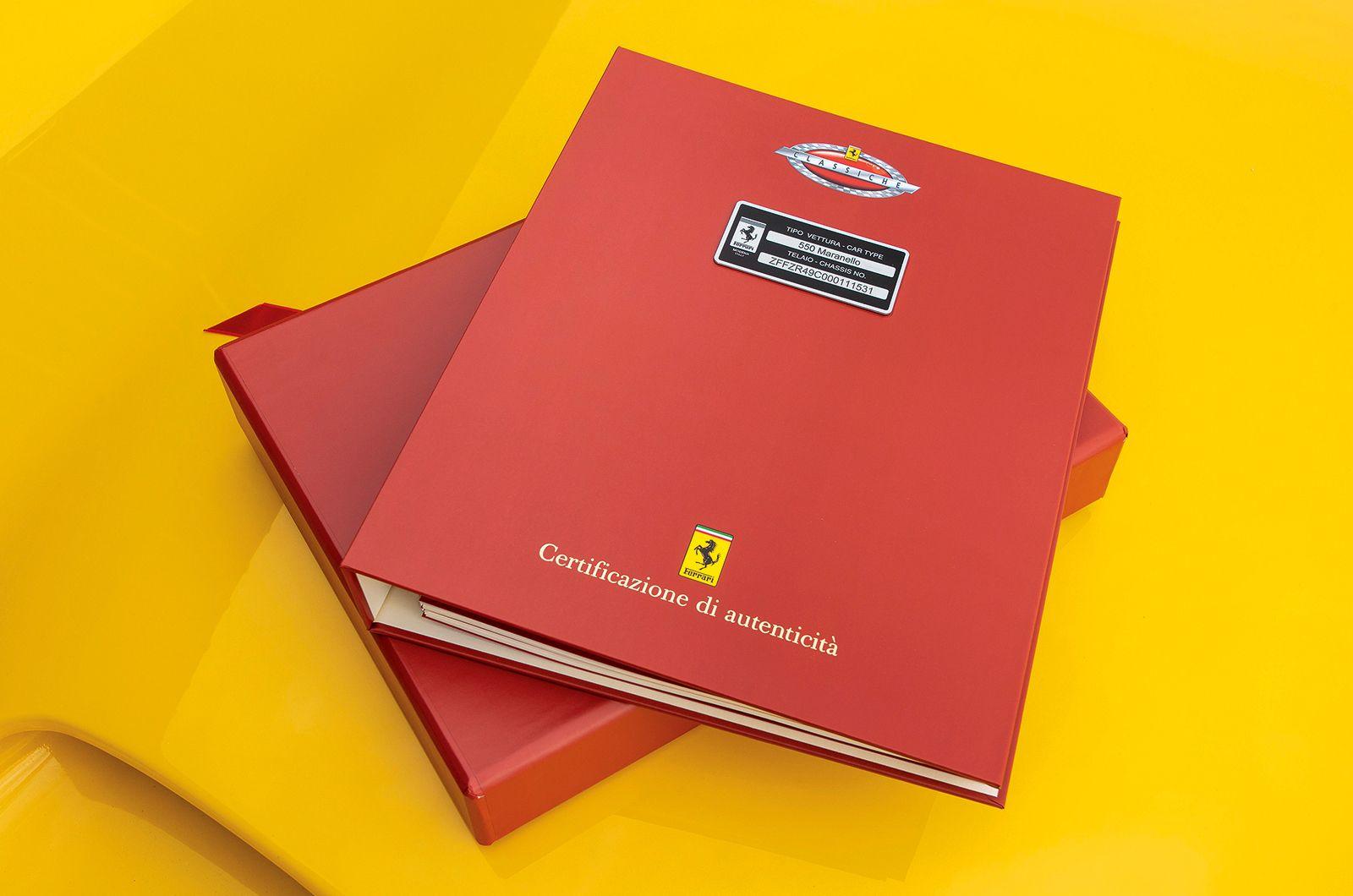
Ferrari Classiche inspects the car. Set up in 2006, it certifies road cars more than 20 years old as well as Special Series, competition, and Formula 1 cars. The chassis must be original. Body and interior are compared with the delivered specification, and mechanical and electrical systems are checked in depth. Most inspections happen at authorised dealers, with Maranello handling difficult cases and metallurgical tests. A certification committee then accepts or rejects the file, and a car that passes receives the Certificate of Authenticity, the Red Book.
What the Red Book cannot cover is a car that history has changed. For significant cars modified away from their delivered specification, Ferrari has offered since 2009 a lesser Attestation for Vehicles of Historical Interest, bound in ivory rather than red. The race-modified 250 GT SWB "Breadvan" is the case usually cited.
Ferrari does not advertise its fees, but a January 2019 Ferrari North America price list, public through an NHTSA filing, ran from $5,904.78 for a 308 to $17,714.33 at the top, before taxes and extras. Certification is reported to take four to six months or more. For the Tier 1 and Tier 2 cars in our Ferrari investment guide, the Red Book is close to a condition of sale.
Porsche: Certificate of Authenticity and the Porsche Classic Technical Certificate
Porsche sells one of each, and buyers confuse them constantly. The archive extract is the document collectors still call the Certificate of Authenticity. Porsche renamed it the Porsche Production Specification in 2019. Drawn from the factory production records, it lists options, colours, engine and transmission type, and completion date. For older cars that record is the Kardex card, which Porsche itself does not release. In the US the document costs $150 and takes six to eight weeks.
Nobody inspects the car. And, in Porsche's own words, it "does not document engine or transmission serial numbers."
A buyer who wants to know whether a 911 still has the engine it was built with needs the inspection, the Porsche Classic Technical Certificate. A Porsche Classic Partner records the engine and gearbox numbers actually fitted and checks them against the factory record. It launched in Germany in August 2019 and costs from $500 plus tax in the US. For the air-cooled cars in our Porsche investment guide, matching numbers is the whole game, and of Porsche's two documents only the inspection tests it.
Lamborghini Polo Storico
Polo Storico is an inspection. Lamborghini opened the department at Sant'Agata Bolognese in spring 2015, covering models from the 350 GT to the last Diablos. Technicians check each component against the archive in a technical area inside the factory, a process that can take hundreds of hours, and a committee drawn from across the company signs off the result.
A car can pass with replaced parts if the parts are correct. Unsupported changes are another matter: Polo Storico withholds documentation for, say, SV wheels on a P400. The fee is reported at €7,000 to €10,000 depending on model, and a car that fails receives a nonconformity report at no further charge beyond logistics.
That strictness is the point on a Miura SV, where converted P400 and S cars have circulated for decades. The paperwork separates the asset from the costume, as our Lamborghini investment guide argues.
Mercedes-Benz Classic Center
The Mercedes-Benz Classic Center in Fellbach, near Stuttgart, sells both instruments, at very different prices. The extract is a copy of the car's original data card, the factory record of its specification, reported at $150 through the US Classic Center in 2022. The inspection is the Hersteller-Expertise, a manufacturer's report that checks matching numbers against the archive and tests material samples in a laboratory. The German trade press reported its price at €20,000 net in 2023, and a 2026 report put a certificate of authenticity at €25,000.
That sounds expensive until it is set against the 300SL Gullwing in our Mercedes-Benz investment guide. An alloy-bodied Gullwing sold for $9.355 million at RM Sotheby's Rudi Klein Collection sale in October 2024, and a good steel car trades for a fraction of that. Against a gap that size, the expertise is cheap insurance.
BMW Group Classic
BMW also sells both, and its extract is, fittingly, called a Birth Certificate. Since early 2024, BMW Group Classic in Munich has issued it digitally, at a reported €125 including VAT. It lists chassis and engine numbers and production and delivery dates, plus the gearbox number and options for cars from the 1980s on. Carscoops put it plainly: "the document is not a certificate of authenticity."
The inspection is a factory expertise report, for which BMW publishes no price. A 507 that Bonhams offered at Scottsdale in January 2023 had been "returned to BMW Classic for an extensive inspection and factory expertise report" in 2014. BMW Group Classic also restores: it confirmed the identity of Elvis Presley's 507 from a 1958 insurance proposal before a restoration of almost two years. For the 507 and M1 in our BMW investment guide, the factory record is the starting point and period documentation does the rest.
Jaguar Heritage
Jaguar's heritage certificate is an archive extract, nothing more. It comes from the Jaguar Daimler Heritage Trust, a charity at the British Motor Museum in Gaydon that operates as the Jaguar Heritage Trust. For cars over ten years old, it records original colour and trim, build and despatch dates, original destination and, where recorded, registration. It is listed at £65 plus VAT and postage.
The Trust is unusually candid about its limits. "We do not inspect vehicles," it says, and the certificate "is not in itself confirmation of the identity, provenance, originality or present condition" of the car. Jaguar does not advertise an inspection-based equivalent of a Red Book.
For the competition cars in our Jaguar investment guide, that gap matters. Jaguar's six continuation Lightweight E-Types carry the original series chassis numbers of the "missing" cars from the original allocation of 18.
Aston Martin Works and the Aston Martin Heritage Trust
Aston Martin splits the two instruments between two institutions, which is why they get confused. The extract comes from the Aston Martin Heritage Trust, a charity that holds the factory build sheets. Its Heritage Certificate, listed at £100, is "taken directly from the build sheet." The Trust notes that its certificates are "not accepted by the DVLA as official documents," and it does not grade originality.
The inspection runs through Aston Martin Works at Newport Pagnell. Its Assured Provenance programme, launched in September 2015, puts a car through a visual and mechanical investigation before a sanctioning committee grades it. The fee for full Works certification is not published. A lighter, dealer-inspected tier added in 2019 was reported from £3,995 plus tax.
The distinction matters for the DB4 GT Zagato and DB5 in our Aston Martin investment guide. Aston has itself sanctioned or built Sanction II, Sanction III, and Continuation Zagatos, and 25 DB5 Goldfinger Continuation cars.
McLaren Special Operations: McLaren F1 Certified
McLaren's programme is the least known here. It is an inspection, and it reaches past identity. McLaren F1 Certified, launched by McLaren Special Operations in August 2018, checks a car against the factory archive and issues a Certificate of Authenticity with an illustrated book covering originality, provenance, service life, condition, and race history.
Certification is available only at McLaren's Woking headquarters, and McLaren does not publish the cost. One full job shows the scale: restoring and certifying chassis 063 took 18 months and nearly 3,000 hours.
Factory history shows up in the price. Chassis 014 sold for $25.3 million at RM Sotheby's Abu Dhabi in December 2025. The factory had fitted it with the High Downforce Kit and an LM-specification interior. That is part of why it sits well above the roughly $14.7 million The Classic Valuer gives an average road car, as our McLaren investment guide sets out.
The Eight Programmes at a Glance
- Ferrari, Ferrari Classiche (Maranello and authorised dealers): certifies the original chassis, and the body, interior, mechanical and electrical systems against the delivered specification. Inspection, committee decision. Cost $5,904.78 to $17,714.33 by model, before taxes and extras (Ferrari North America price list, January 2019). Issues the Red Book, with an ivory Attestation for modified historic cars; four to six months or more.
- Porsche, Production Specification (formerly the Certificate of Authenticity): certifies options, colours, engine and gearbox type, and completion date. Document only, with no engine or gearbox serial numbers. Cost $150 in the US (2026). Six to eight weeks.
- Porsche, Porsche Classic Technical Certificate: certifies the engine and gearbox numbers actually fitted, checked against factory records. Inspection at a Porsche Classic Partner. Cost €499 (Germany, 2019), or from $500 plus tax (US, 2026). Does not replace a full appraisal.
- Lamborghini, Polo Storico (Sant'Agata): certifies each component against the archive, from the 350 GT to the Diablo. Inspection inside the factory, committee sign-off. Cost €7,000 to €10,000 by model (reported, Classic & Sports Car, 2022). Failed cars get a nonconformity report; the department also restores.
- Mercedes-Benz, Classic Center (Fellbach): the data card gives the factory specification, and the Hersteller-Expertise checks matching numbers against the archive with lab-tested materials. Data card is a document, the Expertise an inspection. Cost: data card $150 (2022); Expertise €20,000 net (2023), €25,000 (2026). The Expertise takes several weeks.
- BMW, BMW Group Classic (Munich): the Birth Certificate gives chassis and engine numbers and production and delivery dates; a factory expertise report adds an inspection. Birth Certificate is a document, the expertise an inspection. Cost: Birth Certificate €125 including VAT (2024); expertise not published. The Birth Certificate is not an authenticity certificate.
- Jaguar, Jaguar Daimler Heritage Trust (Jaguar Heritage): certifies colour, trim, build and despatch dates, and destination. Document only ("We do not inspect vehicles"). Cost £65 plus VAT and postage (2026). For cars over ten years old; no inspection-based Jaguar equivalent is published.
- Aston Martin, Aston Martin Works, Assured Provenance (Newport Pagnell): certifies originality, graded by a sanctioning committee. Inspection. Cost: full certification not published; a dealer-inspected tier from £3,995 plus tax (2019). The Heritage Trust separately sells a £100 build-sheet certificate, document only.
- McLaren, McLaren Special Operations, McLaren F1 Certified (Woking): certifies originality, provenance, service life, condition, and race history against the archive. Inspection. Cost not published. Launched 2018; chassis 063 took 18 months with restoration.
Fees are in the currency in which they were published or reported, with the year of the figure.
What Certification Costs, and Where It Belongs in the Math
Certification is not one of the four factors. It is a cost, and it belongs on the same spreadsheet as storage, agreed-value insurance, and specialist maintenance, the carrying costs every marque guide here runs before calling a car an investment. Unlike those, it is mostly paid once, at purchase.
And the fee is the smallest part of it. An inspection that finds a non-original gearbox or incorrect trim produces a list. The bills arrive when the car is brought into conformity with period-correct or factory remanufactured parts.
At the far end sits a full factory restoration, which ends in certification. Hagerty reported in July 2020 that Polo Storico charged $275,000 to $330,000 (£225,000 to £270,000) for one. By the same report, Aston Martin Works charged $545,000 (£425,000) plus tax. Ferrari Classiche's director put a complete restoration at fourteen months.
Proportion decides whether any of this is worth doing, and Ferrari's own price list makes the point. The $16,533.37 it charged to certify a 250 GTO is about three hundredths of one percent of the $51.7 million a GTO made in 2023. The fee for a 308 is a real percentage of a car that trades in five or low six figures, before any parts the inspection demands. As everywhere in the carrying-cost math, fixed costs shrink as a share of value as value rises.
Documented Versus Undocumented: The Spread in Real Results
Isolating a certificate's value is hard, because certified cars also tend to be better cars.
The certificate on its own. In the same Hagerty feature, Francesco Stevanin, then running Lamborghini's Polo Storico, put it this way: "The added value percentage, between a certified and an uncertified car, is between 15 and 16 percent, in the general market." That is a seller of certification talking.
An independent check published the same month by The Classic Car Trust compared 2020 Ferrari sales. Certified cars came out about 19 percent ahead among Daytonas and about 22 percent ahead among 250 GTE 2+2s. The author called it preliminary, and the samples are tiny. Together they suggest a premium in the mid-teens to low twenties where certification is common, on thin evidence.
What the paper proves. Put those results next to cars whose documents establish what they are, or what they have done, and the gaps run to multiples.
- Ferrari 365 GTB/4 Daytona: three certified cars averaged $576,300, against two uncertified at $483,500. The file proves certification alone (2020 sales).
- Ferrari 250 GTE 2+2: a certified car made $383,000, an uncertified one $313,000. Certification alone (2020 sales).
- Jaguar Lightweight E-Type: the original, chassis S850667, made $7.37 million (Bonhams Scottsdale, January 2017); a factory continuation, S850670, made $797,000 (Gooding Pebble Beach, August 2025). The file proves identity: original, not continuation.
- Aston Martin DB4 GT Zagato: a 1962 original made $9,520,000 and a Sanction II (DB4GT/0196/R) $2,755,000, in the same sale (RM Sotheby's Monterey, August 2021). Identity: original, not Sanction II.
- Aston Martin DB5: the Bond gadget car, DB5/2008/R, made $6,385,000 (RM Sotheby's Monterey, August 2019); a standard 1965 saloon made $500,000 (RM Sotheby's Monterey, August 2025). Identity: the film car.
- BMW 507: John Surtees's one-owner car made $5.03 million (£3,809,500) (Bonhams Goodwood, July 2018); a Series II car made $2,315,000 (Bonhams Audrain, September 2022). History: one owner.
- BMW M1: an unraced, as-delivered Procar made $1.6 million (Broad Arrow Monterey, August 2025); a 1979 road car $516,500 (RM Sotheby's Monterey, August 2024). History: unraced, as delivered.
When the paper proves identity. The Sanction II is the sharpest case. One of four completed around 1991 under unused period chassis numbers with the factory's blessing, it sold with an Aston Martin Lagonda certificate of authenticity. The certificate was genuine. It certified a car worth less than a third of an original.
The Lightweight E-Type makes the same point over eight years. Jaguar completed 12 originals in 1963 and 1964, then built six continuations in 2014 and 2015 to the original specification. Same maker, same specification, nine times the price: the difference is a matter of record.
When the paper proves history. The BMW rows turn on who owned a car and how it was used. The unraced Procar set the M1's auction record at the time, at about three times what the road car made a year earlier. A Lamborghini makes the point without a pair. At Broad Arrow's Amelia Island sale in March 2026, Miura SV chassis 4976, after 52 years in one owner's hands, set the model's auction record at the time. It made $6,605,000 against an estimate of $3.5 million to $4 million.
None of the identity or history cases is a certificate premium. All are documentation premiums.
What Certification Does Not Do
It does not guarantee value. The white 250 GTO that opened this page had its Red Book and still sold far below the 2023 GTO, with coverage linking the gap to a replacement engine. A factory-built replacement is still a replacement.
It does not settle every dispute. Experts still argue over factory-sanctioned cars. When Bonhams sold a Sanction III Zagato at the Goodwood Revival in September 2025, for about $1.46 million (£1,079,000), it noted that authorities disagree on whether its chassis platform is DB4 or modified DB6. Independent historians and registries remain essential.
It does not judge restoration quality. A certificate says the parts are correct, not whether the paint is good, the rebuild competent, or the car over-restored. A marque specialist's pre-purchase inspection is still required.
It does not make a continuation car an original. Jaguar and Aston Martin have built continuation cars under old names, and Polo Storico recreated the lost Countach LP 500 prototype for a collector in 2021. Their factory paper is accurate. It says what they are, and the market prices them accordingly.
It does not stop forgery. A certificate attached to a restamped chassis is worth less than nothing. On a seven-figure car, verify the certificate with the issuer and have the stampings checked by someone who has seen genuine ones.
The Certificate Is the Floor, Not the Price
Think of a classic car certificate of authenticity as the floor under factor two. Without one, on a car where certification is standard, the buyer underwrites identity risk personally and the market charges for it. With one, the buyer has bought confidence about what the car is and nothing about what it will be worth.
The market's real premium is for the whole file: factory record, inspection, ownership chain, race history, invoices. For an allocator, the discipline comes down to four steps:
- Know which instrument the seller is holding: an archive extract or an inspection.
- Verify it with the issuer.
- Price the history it does not cover.
- Count certification as a cost of ownership.
Certification reduces identity risk. It does not remove market risk, and past results are no guide to future ones.
Frequently Asked Questions
Q: What is a classic car certificate of authenticity? It is a document from a manufacturer's heritage department about a specific chassis, and it comes in two kinds. An archive extract, such as Porsche's Production Specification (the former Certificate of Authenticity) or a Jaguar Heritage Certificate, reports what the factory recorded when the car was built, without inspecting it. An inspection-based certification, such as Ferrari Classiche's Red Book, confirms after a physical examination that the car still conforms to that record. Only the second tells you whether the car in front of you is still the car the factory built.
Q: How much does Ferrari Classiche certification cost? Ferrari does not advertise a fee. Its January 2019 North America price list, public through an NHTSA filing, set certification by model before taxes: $5,904.78 for cars such as the 308, Testarossa, F355, and 550, and $9,447.64 for the F40, Enzo, and 275 GTB. A 250 GTO cost $16,533.37, and the list topped out at $17,714.33. Archive research and metallographic tests cost extra on many older cars, and the process is reported to take four to six months or more. The bigger bill is often the parts needed to bring a car into conformity.
Q: Is a Porsche Certificate of Authenticity worth getting? Yes, as a first step. Now called the Porsche Production Specification, it costs $150 in the US and confirms the factory options, colours, and engine and gearbox type. It is a document, not an inspection, and Porsche states that it does not record engine or transmission serial numbers. To test matching numbers, a buyer needs the inspection-based Porsche Classic Technical Certificate (from $500 plus tax in the US) or a marque specialist's check of the stampings.
Q: Does the Aston Martin Heritage Trust certify cars? Not in the authentication sense. The Trust holds the factory build sheets, and its £100 Heritage Certificate is taken directly from them. That describes how the car was built, not whether the car in front of you is still that car. Inspection-based certification runs through Aston Martin Works at Newport Pagnell and its Assured Provenance programme.
Q: How much does certification add to a car's value? There is no reliable universal figure. Lamborghini's Polo Storico chief told Hagerty in July 2020 that certified cars carry a 15 to 16 percent premium in the general market. A small study by The Classic Car Trust that year found certified Ferrari Daytonas about 19 percent ahead. Both are small or interested samples. Documentation that proves identity or history moves prices far more: at RM Sotheby's Monterey in August 2021, an original DB4 GT Zagato made $9,520,000 and a factory-sanctioned Sanction II made $2,755,000.
Q: Are continuation cars certified as originals? No. Factory continuation cars, such as Jaguar's Lightweight E-Type, XKSS, and D-Type runs or Aston Martin's DB4 GT Zagato Continuation, are built by the manufacturer and documented as what they are. They trade as a separate, lower category. A continuation Lightweight E-Type sold for $797,000 at Gooding Pebble Beach in August 2025; an original sold for $7.37 million at Bonhams Scottsdale in January 2017.

Joseph Chappius — Automotive Journalist
Fifteen years in wealth management. Now writing about collector cars, alternative assets, and the stories behind them. All articles →