Is Ferrari a Good Investment? The Three Markets That Don't Behave Alike
Key Takeaways
- Ferrari is three markets, not one: pre-1970 racing cars, the modern halos from the 288 GTO to the F80, and the production cars that make up nearly everything Maranello builds. Only the first two have historically compounded across cycles.
- Tier 1 is priced chassis by chassis, not model by model. The public 250 GTO record is $51.7 million (RM Sotheby's New York, November 2023), yet the latest GTO at auction made $38.5 million (Mecum Kissimmee, January 2026).
- Tier 2 moved hardest in 2026: every halo from the 288 GTO to the LaFerrari set a new auction record. The same year produced Enzos at less than half the record, and that spread is the risk a buyer has to price.
- Tier 3 is a car, not a position. Production Ferraris such as the 458 and Portofino were built in the thousands, carry Ferrari-specific service bills, and have not historically outrun their carrying costs. The limited specials are the exceptions worth watching, and still a bet.
On January 17, 2026, at Mecum's Kissimmee sale in Florida, two Ferraris sold on the same day and told opposite stories. A 1962 250 GTO, chassis 3729GT and the only GTO the factory finished in white, made $38.5 million. That was more than $13 million below the model's public record. A 2003 Enzo from the Bachman Collection made $17.875 million, more than any Enzo had ever brought at auction. The sixty-four-year-old racing car underwhelmed. The twenty-three-year-old road car made the headlines.
So is Ferrari a good investment? Yes, but only at two of its three tiers, and that day in Kissimmee shows why. Seven months later, Monterey Car Week showed the same split on a bigger stage. The F50, 288 GTO, F40, and LaFerrari all set new auction records inside three days. Across the same week, Autobahn Alpha's lot-level count found sales below $100,000 down about 18% year on year. One badge, three markets, moving in different directions at once.
Why Ferrari as an Investment Means Three Markets, Not One
Run Ferrari through the Autobahn Alpha Four-Factor Screen we apply to every marque on this list (production scarcity, provenance integrity, buyer-base breadth, and cultural resonance), and the result depends entirely on which Ferrari you feed in. The pre-1970 racing cars pass all four with room to spare: production in single or double digits, chassis histories traceable race by race, a bidder pool that RM Sotheby's says spanned 82 countries in 2025, and a cultural footprint no marque matches. The modern halos pass all four as well. They were built in runs of 272 to 1,315 cars, for buyers who grew up with them on the bedroom wall.
The production cars fail the first factor outright. In 2024 alone, Ferrari shipped 13,752 cars, more than three times the combined production of every halo car from the 288 GTO to the F80. A car built in those numbers can be exceptional to drive and still lose value for years, like any luxury good.
The working boundaries are simple enough to apply in an auction room. Tier 1 is a pre-1970 Ferrari built in dozens or fewer, usually with a period race record attached to the specific chassis. Tier 2 is a factory halo car built in the hundreds or low thousands, the flagship of its decade. Tier 3 is everything else, including most of the limited editions Ferrari now releases on a regular schedule.
Our companion piece, Your Portfolio Is on Fire: Go Buy a Ferrari, makes the macro case: why the marque dominates the auction leaderboard, and what the 1989 bubble still teaches. This guide is the model-by-model version.
Tier 1: The Pre-1970 Racing Ferraris
The Ferrari 250 GTO as an Investment: 36 Cars, Priced One at a Time
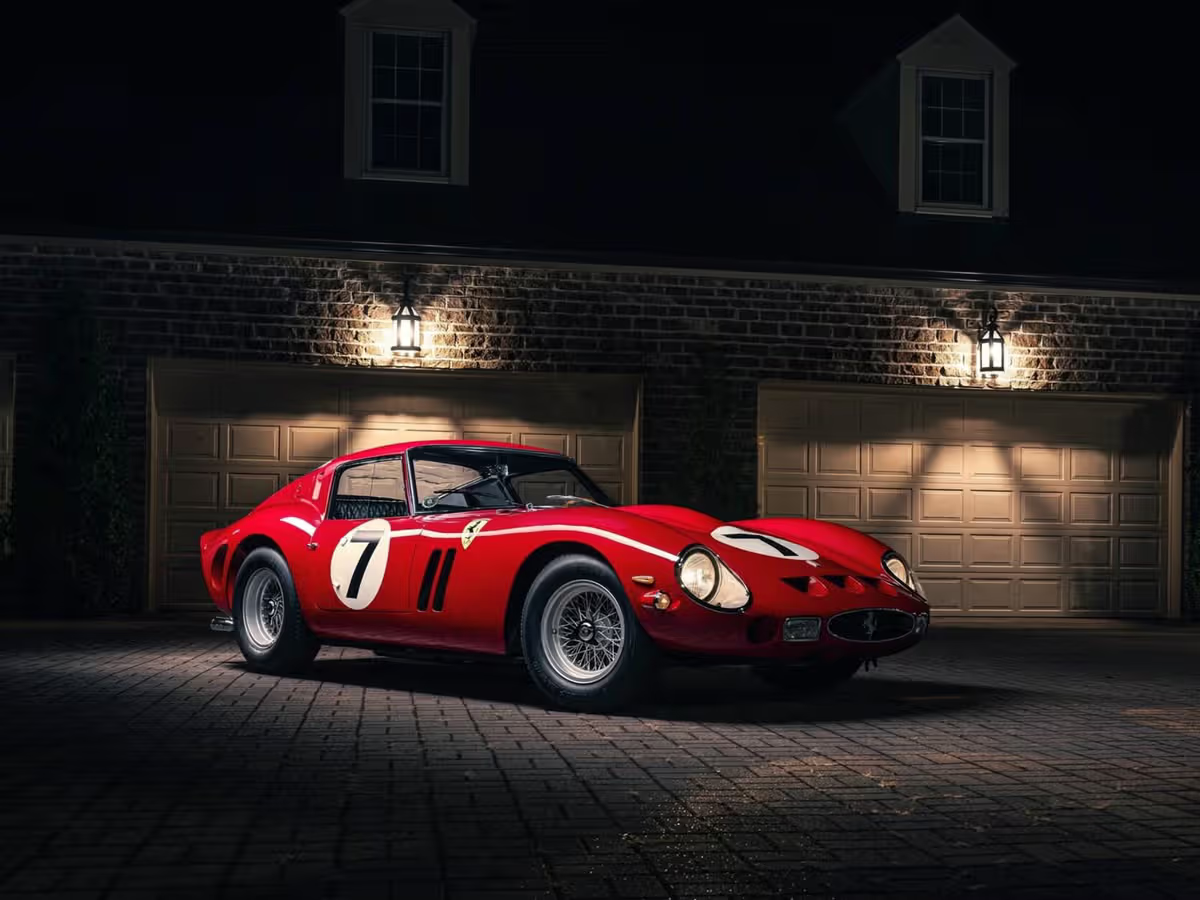
The 250 GTO is the anchor of the marque and, depending on the year, of the whole asset class. By the most common count, Ferrari built 36 between 1962 and 1964. Some registries also count the three four-liter 330 GTOs, which takes the total to 39. Either way, supply rounds to nothing and new supply is zero.
Four GTOs have sold at public auction since 2014, and together they show a market priced chassis by chassis, not model by model. The first made $38.1 million at Bonhams Quail Lodge in 2014. In August 2018, another made $48.4 million at RM Sotheby's Monterey. The current public record belongs to a factory car first raced at Le Mans in 1962 with a four-liter engine. It made $51.7 million at RM Sotheby's New York in November 2023. Then came the white Kissimmee car, the Bianco Speciale GTO ordered by British privateer John Coombs, at $38.5 million. One more GTO was widely reported to have changed hands privately for about $70 million in 2018, a figure never officially confirmed.
The lesson for anyone estimating a Ferrari 250 GTO value is that there is no single GTO price. Race history, originality, and the story of one specific chassis set the price. Two GTOs sold nearly twelve years apart landed within half a million dollars of each other. Over long holding periods the cars have compounded. Over any given sale, the chassis decides.
The Rest of Tier 1: Sports Racers, the SWB, and the NART Spider

The sports-racers at the top of that table almost never trade, and when they do, the price reflects one car's racing history. For an allocator, the most useful Tier 1 car is the 250 GT SWB California Spider, because it trades often enough to be measured. Road-specification SWB Spiders sold three times in 2026 alone:

Three sales inside three months, within about $3 million of each other, is about as close as Tier 1 comes to a going rate.
Modern Formula 1 cars with championship provenance belong in this conversation too, because they trade on story the way the sports-racers do. Michael Schumacher's F2001 sold for $7.5 million at Sotheby's New York in 2017. In May 2025 it sold again at RM Sotheby's Monaco, for $18.39 million (€15.98 million), more than double. Nothing about the car changed between the two sales except what the market would pay for its history.
Tier 2: Modern Halo Ferraris, From the 288 GTO to the F80

For capital that is serious but not dynastic, this is the tier where the answer to "is Ferrari a good investment" has most often been yes. It is also the tier that moved most in 2026. Our Monterey 2026 analysis found a median of $10.7 million across the halo Ferraris tracked from this era, against $4.5 million for the equivalent group a year earlier. The right-hand column of the table is the reason to buy with care: the same models also sold for far less in 2026.
The F40 and 288 GTO: The Analog Pair
The 288 GTO is the rarest of the halos, at 272 cars. It was a homologation special, built so Ferrari could qualify for Group B racing, and the series was cancelled before it could compete. In August 2026, a 1985 car made $11.555 million at RM Sotheby's Monterey, beating the prior model record of about $10.9 million. Six months earlier, a 288 GTO had made about $7.0 million in Paris.
The F40 has the largest production of the halos: 1,311 cars in most auction-house catalogs and 1,315 in other references. Of those, 213 were built for the US market. The F40 also trades more often than any other halo, which is why our F40 investment guide treats it as the benchmark modern blue chip. The new record belongs to a 320-mile 1991 car bought new by Lee Iacocca, which made $8.365 million at Monterey. That beat the prior high of $6.6 million by more than a quarter. Four months earlier, a 1989 F40 made about $5.1 million at Monaco.
The F50, Enzo, and LaFerrari: The V12 Trilogy
The F50 shows how fast a halo's price can move once buyers decide it was too cheap. It set three auction records in twelve months, on a production run of 349 cars. The first came at RM Sotheby's Monterey in August 2025, where a Giallo Modena (yellow) car bought new by Ralph Lauren made $9.245 million. Hagerty put that at roughly two-thirds above the previous F50 record. In January 2026, a 252-mile car made $12.21 million at Mecum Kissimmee. Then in August, a Classiche-certified Giallo Modena car made $14.575 million at Mecum Monterey.
The Enzo is the cautionary half of the same story. Its $17.875 million record in Kissimmee belonged to one yellow car with a specific history. Eleven days later, another Enzo made about $9.6 million (€8.11 million) at RM Sotheby's Paris. In April, one made about $7.7 million at Monaco. At Monterey in August, three more sold between $9.41 million and $12.1 million. The record was set by one car. It was never the going rate.
The LaFerrari, the last V12 of the trilogy, has lagged both. Its new coupe record of $8.695 million barely cleared the prior high of $8.58 million.
The F80 and the Icona Question
The F80 is the next halo: 799 cars at a base price of about $3.9 million (€3.6 million). It replaces the V12 that ran from the F50 through the LaFerrari with a hybrid V6. Every car was allocated before production began. Whether it joins Tier 2 or becomes an expensive used hypercar depends on how broad its buyer base proves, which takes a decade, not a delivery cycle.
The harder question is Ferrari's Icona series of limited-run cars, which includes the 599-car Daytona SP3. In August 2026, RM Sotheby's Monterey sold a 2023 SP3 with 227 miles on it. It made $17.825 million against a $10 million to $12 million estimate, more than any F40 or F50 has ever made. Either the market is recognizing a naturally aspirated V12 limited series early, or buyers paid a flip premium (the markup on reselling a near-new car) on a scale the asset class has rarely seen. Both can be true. Until the market settles it, the SP3 is a live test of how to spot a future classic, the riskiest game in collecting. Size it accordingly.
Tier 3: The Production Ferraris That Don't Compound
Everything else Ferrari builds is Tier 3: the 360 and F430, the 458, the California and California T, the Portofino and Roma, and the current hybrids. The 360 coupe and spider alone ran past 16,000 cars by the commonly cited count. These are some of the best-engineered sports cars ever sold, and they behave the way production exotics usually do. They lose value steeply when new, then settle onto a long plateau where condition and mileage, not scarcity, set the price.
The 2026 market made the split visible. While the halo median more than doubled at Monterey, total sales below $100,000 fell about 18% year on year. The money that poured into Ferrari went to the top two tiers and to the specials at the very top of Tier 3. Those include the 360 Challenge Stradale, the 458 Speciale, the 599 GTO, and the handful of gated-manual cars Ferrari built as it phased out the stick. They are the modern Ferraris with the strongest future-classic claims, and some have appreciated well. But a limited run inside a model family built in the tens of thousands is a candidate, not a proven compounder. Pricing a standard 458 as if it were a Speciale is the most common error in this marque.
So are Ferraris a good investment as a category? Not below the halo line, where most Ferraris do not appreciate in value once costs are counted. None of this makes a production Ferrari a poor purchase. It makes it a consumption decision with a residual value, which is a different spreadsheet. The buyer who wants one should buy the best-documented example at a used-car price, budget the full service schedule, and treat any appreciation as a gift. The mistake is paying a premium on the theory that the badge will eventually carry the car into Tier 2. Historically, it has not.
Running the Carrying-Cost Math
Every car worth owning in this guide first passes the Autobahn Alpha Four-Factor Screen. The Tier 1 and Tier 2 cars pass all four factors, and the production cars fail scarcity. The second test is separate, and it is pure arithmetic: a collector car has to outrun storage, agreed-value insurance, and specialist maintenance before it returns a real dollar.
Ferrari makes that arithmetic unusually specific, because its service schedules are expensive and run on the calendar as much as the odometer. The F355's major belt service means taking the engine out, and owners and specialists report bills of roughly $6,000 to $12,000 depending on the shop. The 360's belts come out with the engine in place, on a three-year interval, at a reported $3,000 to $6,000. Later V8s such as the 458 moved to timing chains. At the top, Ferrari recommends replacing the F40's rubber fuel cells every ten years. One owner's widely reported bill for a "small" F40 service, covering belts, fluids, and refurbished tanks, came to roughly $80,000 (about €70,000).
Now scale those bills against the asset. On an $8 million F40, an $80,000 service year is 1% of value, and most years cost far less. On a $150,000 production Ferrari, storage and insurance run maybe $4,000 to $6,000 a year before a wrench turns. Add the amortized belt service and an annual inspection, and the drag lands around 4% to 7% of value every year, on a car that has not historically appreciated at that rate. Tier 1 and Tier 2 have historically covered their costs by wide margins. Tier 3 mostly has not.
Documentation is the other carrying cost, and on a Ferrari it is the one that pays. Ferrari Classiche, the factory's certification arm, issues its Certificate of Authenticity and Red Book to road cars at least twenty years old. Ferrari does not advertise its fees, but a January 2019 Ferrari North America price list, made public through an NHTSA filing, shows the scale. Certification ran from about $5,900 for a 308 to $16,530 for a 250 GTO, with an F40 or Enzo at $9,450, all before taxes and testing. Dealers report waits of four to six months or more. Ferrari has claimed certified cars gain 15% to 20% in value, a figure at least one long-established dealer calls optimistic. Our guide to what each marque's certification actually covers compares Classiche with its rivals. On a Tier 1 or Tier 2 Ferrari, an uncertified car is a discount waiting to be asked for.
Ferrari vs. the Rest of the Alt-Asset Field
Against the other blue-chip marques, Ferrari holds the second rung of the ladder, and the deepest catalog behind it.

Mercedes holds the all-time record, and holds it with cars that almost never trade. Ferrari's distinction is depth: at least ten different Ferrari models have made more than $15 million at public auction, and the halo tier puts several tradeable models beneath them. Porsche's case is breadth at lower prices. Ferrari's is concentration at the top.
Against traditional assets, the collector-car sector as a whole has cooled, while Ferrari's top end has not. Knight Frank's Luxury Investment Index closed 2025 down 0.4% after two years of losses. Its 2026 Wealth Report called 2025 a subdued year for classic cars, with the $9.2 million F50 at Monterey 2025 among the highlights. The data on collector cars as an asset class supports a satellite allocation for the scarce top of the market, not a bet on the average car.
What to Watch in 2026 and 2027
Whether halo prices hold. Watch the second-best results, not the records, because they show the going rate. If well-documented Enzos and F50s keep selling above $10 million without a famous first owner, the whole tier has moved up. If they slide back toward the Monaco numbers, the 2026 records were about specific cars.
The end of the V12 halo line. The F80's V6 makes the F50, Enzo, and LaFerrari a closed V12 set, the kind of permanent scarcity the market pays for. Ferrari's 2030 plan calls for a mix of 20% electric, 40% hybrid, and 40% combustion. Its first electric car, the Luce, has first deliveries reported for late 2026.
Slower gains in Tier 1. A GTO sold near what a different GTO made in 2014, and SWB Spiders are clustering in the mid to high teens of millions. Both suggest the pre-1970 cars are compounding more slowly than the halos. That is normal for a dynastic tier. It is also the kind of entry point patient capital tends to wait for.
Money concentrating at the top. Watch sell-through rates (the share of cars offered that actually sell) at the next Kissimmee and Monterey sales as closely as the hammer prices, because a concentrated market can thin quickly. At Monterey 2026, sales of cars above $5 million totaled $315 million, up from $126 million a year earlier. Eight of the week's eleven eight-figure sales were Ferraris.
A generational handoff. Cerulli Associates projects roughly $124 trillion in wealth transfer through 2048. The buyers inheriting it grew up with the F40 and F50, not the GTO. That is a tailwind for Tier 2 and softer demand for parts of Tier 1.
Fractional ownership. Fractional shares and special-purpose vehicles (SPVs) now let an investor hold a Tier 1 or Tier 2 Ferrari without sourcing, storing, insuring, and certifying the car personally. At these prices, they are often the realistic route in, though diligence on fees, exit timing, and Classiche status still varies by manager.
The Ferrari Thesis Is Two Tiers and a Discipline
Is Ferrari a good investment, then? Ferrari is the marque where the investment case is strongest and the badge is most misleading. The pre-1970 racing cars are finite cultural objects, priced chassis by chassis, and over long holding periods they have compounded through more than one cycle. The halo cars, from the 288 GTO to the LaFerrari, are where accredited capital can actually participate, and 2026 showed both their upside and their risk in the same twelve months. A record Enzo and one at little more than half the price sold eleven days apart, and both were genuine.
Everything beneath that is a car. Often a brilliant one, and occasionally a special worth watching, but the production Ferraris have not covered their costs and are not built in numbers that let them. The word "Ferrari" is not the investment thesis. The tier, the chassis, the record, and the Red Book are. Know which of the three markets you are buying into, and size the halo tier as the volatile asset it has become. Do that, and Ferrari remains the deepest blue-chip catalog in the field.
Frequently Asked Questions
Q: Is Ferrari a good investment? Yes, but only at two of three tiers. Pre-1970 racing Ferraris (the 250 GTO, 250 LM, 250 GT SWB California Spider, 250 Testa Rossa, and 275 GTB/4*S NART Spider) and the modern halo cars (288 GTO, F40, F50, Enzo, and LaFerrari) have compounded across market cycles. Production Ferraris such as the 360, F430, 458, California, and Portofino are built in large numbers and have historically not cleared their carrying costs. Past performance does not guarantee future results.
Q: What is the best Ferrari to invest in? It depends on capital. Documented pre-1970 racing Ferraris have the longest record of appreciation, with headline public results running from the mid-teens of millions to $51.7 million. For most accredited investors, the halo tier is where the math works: F40s traded between about $5 million and $8.4 million in 2026, with the 288 GTO, F50, Enzo, and LaFerrari alongside or above them. Below the halos, limited specials such as the 458 Speciale are a future-classic bet.
Q: How much is a Ferrari 250 GTO worth? The public auction record, and the most any Ferrari has made at auction as of October 2026, is $51.7 million (chassis 3765, RM Sotheby's New York, November 2023). Other public results include $48.4 million (RM Sotheby's Monterey, 2018), $38.1 million (Bonhams Quail Lodge, 2014), and $38.5 million for the white 3729GT (Mecum Kissimmee, January 2026). Chassis 4153GT was reported to have sold privately for about $70 million in 2018.
Q: Is the Ferrari F40 a good investment? It has been one of the strongest modern Ferrari performers. Ferrari built between 1,311 and 1,315 (sources differ), and the auction record reached $8.365 million at RM Sotheby's Monterey in August 2026 for a 320-mile car first owned by Lee Iacocca, up from a prior record of $6.6 million. Other examples traded around $5 million earlier in the year. Costs such as the ten-year fuel-cell replacement are real but small against the car's value.
Q: Are modern Ferraris like the 458 or Portofino good investments? Generally not. Production Ferraris are built in the thousands or tens of thousands, depreciate steeply when new, and then trade on condition and mileage rather than scarcity. Once storage, insurance, and Ferrari's time-based service schedules are counted, the annual drag on a $150,000 car can run several percent of its value. Limited specials are the exceptions worth watching, but they remain candidates rather than proven compounders.
Q: How do I invest in a Ferrari without buying one outright? Fractional and SPV-structured ownership platforms now offer accredited investors exposure to investment-grade Ferraris, from halo cars to pre-1970 blue chips, without sourcing, storing, insuring, and certifying the car personally. At Tier 1 and Tier 2 prices, structured exposure is often more practical than sole ownership, though diligence on fees, exit timing, and Classiche status varies by manager.

Joseph Chappius — Automotive Journalist
Fifteen years in wealth management. Now writing about collector cars, alternative assets, and the stories behind them. All articles →