How to Spot a Future Classic Car: A Screening Method
Key Takeaways
- A future classic is a recent car, typically 10 to 25 years old, that already passes three of the four factors in the Autobahn Alpha Four-Factor Screen (production scarcity, provenance integrity, buyer-base breadth, cultural resonance). That can be checked today. Twenty-year taste cannot.
- The clearest signals are visible now: a short run inside a famous model line, an original and documented car, and the 25-year import clock. Segment indexes show a cohort's direction, not its price, and only when read with their dates.
- Future-classic prediction has been wrong more often than right. Cars with a lasting premium over their ordinary siblings (NSX, LFA, R34 GT-R) are safer bets, not safe ones: an R34 V-Spec II Nür sold for about half its mid-estimate in May 2026.
- Future classics fail in consistent ways: bought above MSRP at delivery, high production dressed as a limited edition, or hoarded by so many owners that survivor scarcity never arrives.
In May 2025, at Broad Arrow's sale alongside the Concorso d'Eleganza Villa d'Este, a 2003 Honda NSX-R sold for $1.06 million (€934,375), at the time a world auction record for an original NSX. A year later, at the same sale, Broad Arrow offered five Nissan Skyline GT-R R34s from one collection without reserve. The V-Spec II Nür, one of 718 built, sits near the top of almost every list of future classic cars. It sold for about $241,000 (€207,000), roughly half its mid-estimate. Same venue, same country of origin, same era, same lists. One cleared the bar in public. The other was marked down in public.
That gap is the subject of this guide. "Future classic cars" is the most-searched and most-abused query in the asset class. Most of what sits under it is a wish list with production numbers attached. Our marque-by-marque field guide, the hub for this series, names nine candidates and promises the method behind them. This is that method, checked against current auction data. The honest odds are worse than the marketing suggests.
What Is a Future Classic Car?
A future classic is a recent vehicle, typically 10 to 25 years old, that has not yet settled into a collector price but already shows the traits that made older cars compound. It overlaps with the "modern classic" cohort of cars built between 1985 and 2009, but the two are not the same: many modern classics have already been repriced as collector cars.
The tempting question is which cars will be valuable in twenty years. That is a bet on taste twenty years out, and nobody has a reliable model for taste. The answerable question is narrower: which recent cars already pass three of the four factors in the Autobahn Alpha Four-Factor Screen, which we apply to every marque on this site. The four factors are production scarcity, provenance integrity, buyer-base breadth, and cultural resonance. Put plainly: how few were made, how complete and verifiable the car's history is, how wide the pool of buyers is, and whether the car means something beyond its spec sheet.
Three is the right threshold for this stage of a car's life. A car that passes all four is usually priced as a classic already. A car that passes two is a used car with a fan club.
Carrying costs are a separate test, not a fifth factor. Take a $50,000 car that costs $4,000 to $6,000 a year in storage, insurance, and maintenance. That is 8% to 12% of its value every year, before it appreciates a dollar. Most future classics sit in exactly that price band, where the arithmetic is hardest. That is why the screen has to be strict.
Two companion pieces cover adjacent ground. What makes a car collectible sets out the general traits (rarity, condition, story) and the condition scale. Ten cars that were laughed at when new covers cars that have already made the jump.
The Signals You Can Actually Observe
Segment indexes, read with their dates
Hagerty's segment indexes are the cleanest public signal that a cohort is moving, but only if you read the date next to each number. The big five-year gains Hagerty reported in July 2024 were mostly a 2020 to 2022 story. The readings since have been roughly flat.

Model-level data shows the same shape. Hagerty reported in December 2023 that the Japanese collector cars it tracks averaged 15.6% appreciation in 2022, then 4.5% in 2023. Measured over five years, the gains still look large, and none of these are dynastic-money cars:

Hagerty's 2026 Bull Market List, published in December 2025, includes the 2006 to 2013 Corvette Z06 at roughly $55,900. The wave is visible. But an index tells you where a cohort is pointed. It does not tell you what to pay.
The cohort, or poster-car, effect
Collectible markets follow buyers. People return to the cars they wanted at fifteen once they have capital at fifty. That is how the 300SL and 250 GT became blue chips, and how the F40 followed them. Our lot-level analysis of Monterey 2026 found that cars built from 1985 to 2009 more than doubled their dollar volume year on year, from $91.1 million to $205.9 million. Meanwhile, total sales below $100,000 fell about 18%. The cohort effect is real, but selective. It concentrates at the top of each model line rather than lifting everything the cohort once pinned to a wall.
Last-of attributes
The market pays for endings: the last manual, the last naturally aspirated engine, the last car with hydraulic or unassisted steering. The S2000's 9,000-rpm F20C, the LFA's 9,000-rpm V10, and the unassisted steering of pre-1995 manual NSXs all sit in this category. The Monterey 2026 data showed manual cars still commanding significant premiums over automated equivalents. The signal cuts both ways. The 360 Challenge Stradale was built only with Ferrari's F1 automated gearbox, in a market now paying extra for a clutch pedal.
Homologation and low production inside a known model line
The strongest scarcity signal is a short run inside a famous nameplate, whether a homologation special (a road version built so a model could qualify for racing) or a limited edition. The volume car builds the audience. The special edition captures it. Honda sold more than 18,000 first-generation NSXs worldwide but built fewer than 140 of the 2002 to 2005 NSX-R, per Broad Arrow. BMW built 1,383 E46 M3 CSLs inside an E46 M3 run in the tens of thousands. Nissan built 718 R34 V-Spec II Nür cars. Each special borrows cultural resonance from a car millions recognize, which is exactly the factor a short run cannot manufacture on its own.
Documented originality
For a car this age, the scarce asset is the unmodified, documented survivor, not the model. At 15 to 25 years old, most performance cars have been modified, tracked, crashed, or neglected, so original examples are often scarcer than the production count implies. A 1998 Supra Turbo with a six-speed, a targa roof, and 9,000 miles sold for $220,000 at Mecum Kissimmee in January 2026. Modified and high-mileage cars trade at a fraction of that. For imported Japanese cars, provenance means the paper trail: export certificate, Japanese auction sheet, verified odometer history. Its quality is uneven. Our guide to collector car provenance and certification covers how documentation moves price.
The 25-year import clock
U.S. federal law lets a car not originally built to U.S. standards be imported once it is 25 years old, counted from its month and year of manufacture, not its model year. It is the only forecastable demand event in the sector, and it matters only for cars never sold new in America. The 25-year import rule explains the mechanics. For this screen, it cuts two ways. Eligibility widens the buyer base. It also releases supply that was previously locked in Japan or Europe, which is part of why R34 prices have been uneven since the first cars turned 25 in 2024.
The Candidates, Screened Against Current Data
Each of the hub's nine candidates is scored below, with its main risk. The table that follows holds the auction evidence.
The Japanese candidates
Honda NSX (NA1/NA2). The standard car passes cultural resonance, buyer-base breadth, and provenance, since single-owner, fully serviced cars are common. Scarcity is the partial factor, because Honda built the standard car in the thousands. The NSX-R from our opening shows what all four factors look like together.
Toyota Supra Mk4. Cultural resonance is the whole case, amplified by film and gaming, with buyers worldwide and a premium for unmodified cars. Scarcity is weak: Toyota sold the car in volume, including in the U.S. through 1998. The top of the market has gone sideways since 2022, when a 1994 Turbo made $232,000 on Bring a Trailer. The Mecum Kissimmee car above did not beat it.
Nissan Skyline GT-R, R32 to R34. The GT-R passes on cultural resonance across two generations of gamers, motorsport pedigree (the R32 was built to win Group A touring car racing), and genuine scarcity at the Nür and NISMO level. Provenance is the weak factor, given import paperwork and how many cars have been modified. The main risk is supply. The R34 GT-R was built from 1999 to August 2002, so U.S. eligibility keeps releasing cars through 2027. A 10-km V-Spec II Nür set a $549,000 record at BH Auction in Japan in 2021. Its 2026 results, starting with the Nür in our opening, have been far weaker.
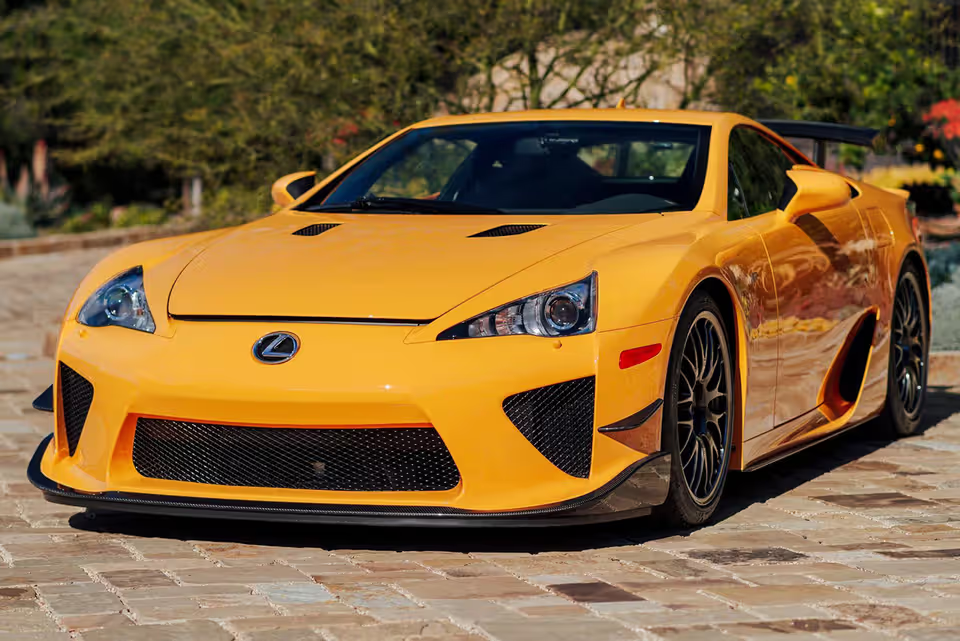
Lexus LFA. Lexus built 500 between 2010 and 2012, and the LFA arguably passes all four factors already: scarcity, a V10 with cultural standing well beyond Lexus, factory-documented provenance, and buyers worldwide. A Nürburgring Package car sold for $1,875,000 at RM Sotheby's Las Vegas in November 2023, against a base price of $375,000 when new. It is the closest thing on this list to a settled classic, which is also its risk: the price already assumes it.
Honda S2000 AP1. The S2000 passes cultural resonance, buyer-base breadth, and provenance for original cars. It fails scarcity: Honda reported 110,673 S2000s sold worldwide through 2008. And because it was sold new in the U.S., the 25-year rule is no catalyst. The investable version is the rare, original, low-mileage car, not the model, and the red flags below show what even a record example returned.
Mazda RX-7 Spirit R. The Spirit R was the FD RX-7's final edition, built from April to August 2002 for Japan only: 1,504 cars. It passes scarcity, cultural resonance, and provenance for documented cars. Its U.S. buyer base opens month by month from April 2027 as the cars turn 25. Rotary maintenance is the carrying-cost risk.
The European candidates
BMW E46 M3 CSL. BMW built 1,383, almost all of them in 2003, and only with the SMG automated gearbox. The CSL passes scarcity, provenance (BMW Group Classic records), and cultural resonance. Buyer-base breadth is its weak factor. The car was never sold new in the U.S., so American buyers generally cannot import one until it turns 25, from 2028. Our BMW investment guide treats it as the leading early-cycle M car.
Porsche 996 GT3 and GT2. These are the water-cooled 911s with the race-derived Mezger engine. They pass provenance (Porsche Certificate of Authenticity) and buyer-base breadth, since Porsche draws buyers worldwide. Cultural resonance is still forming, and scarcity is strongest in the RS. The RS is the version that clears the bar: a 2004 GT3 RS sold for about $363,000 (€303,125) at RM Sotheby's Paris in January 2026. The standard GT3 is the risk. At Broad Arrow's Porsche sale in April 2025, a 33,000-mile 2004 GT3 went unsold. The Porsche investment guide explains why base water-cooled cars do not clear the cost test.
Ferrari 360 Challenge Stradale. The Challenge Stradale passes scarcity within the 360 family, provenance (Ferrari Classiche), and the breadth of Ferrari's buyer base. Ferrari never published a final count, but registries place it between 1,288 and about 1,300. Its main risk, noted above, is that it came only with Ferrari's F1 automated gearbox. Our Ferrari investment guide places it between the halo cars and the production 360s. For later Ferraris, see five modern Ferraris with future-classic potential.

Sources: Hagerty, Broad Arrow, RM Sotheby's, Mecum, Gooding Christie's, Bring a Trailer, Acura.
Red Flags: How Future Classics Fail
Bought above MSRP at delivery. A buyer who pays above sticker on day one has paid for the appreciation in advance. The Porsche 911 R is the cleanest case. Porsche built 991 of them as 2016 models, and used prices edged toward $1 million later that year. Then Porsche offered the next GT3 with a manual gearbox and a Touring package, and the premium came out. Hagerty-recorded sales since have mostly fallen between roughly $305,000 and $555,000: still above list, but far below what the first flippers paid. One car has since made $1,105,000. Hagerty notes it is the exception. Our hub says such premiums typically evaporate within 24 to 36 months. That matches the cases we have traced. No published study fixes the window, though, so treat it as a pattern rather than a rule.
High production marketed as a limited edition. The 1978 Corvette Indy Pace Car replica is the textbook case. Chevrolet built 6,502 of them, about 15% of that year's Corvette production, according to Hagerty. A Wall Street Journal article touted them as future collectibles. Buyers paid well over the $13,653 sticker, and many put the cars straight into storage. In 2024, Hagerty valued a condition #2 L82 pace car at $41,300. That is more than 60% above an ordinary 1978 Corvette. In real terms, though, it is still well below its sticker: $13,653 in 1978 is about $66,000 in 2024 dollars, by BLS consumer price data. Small numbers alone do not rescue an edition either. The 1995 Corvette Pace Car Convertible (527 built) carried a #2 value within a few hundred dollars of a standard car.
Too many garage queens. When enough owners store a car because it is "going to be collectible," the survivor scarcity that rewards real classics never arrives. The 42-mile S2000 that Broad Arrow sold in March 2025 is the best-documented example. Its owner paid $32,440 in 2000. By The Drive's arithmetic, that is about $60,000 in 2025 dollars. The owner kept it unregistered, towed it between houses for 25 years, and sold it for $95,000. That is about 4.4% a year nominal, or under 2% a year after inflation, before a dollar of storage or insurance. And by The Drive's account, it was a record price for an AP1.
Scarcity without resonance. Rarity has to attach to something buyers already care about. The 360 Challenge Stradale works because millions know the 360. A 500-car run of an unloved model has nothing to borrow.
Why Future-Classic Prediction Is Wrong More Often Than Right
The honest caveat on our hub stands: future-classic prediction has been wrong more often than right in the broader asset class. Cars that look obvious at year ten often disappoint at year twenty as taste shifts. The cars on our list that already command a structural premium (NSX, LFA, R34) are safer bets than the cars that depend on a still-forming demographic wave, such as current GT3 RS variants and recent McLaren limited runs. By structural premium we mean a price gap over a car's ordinary siblings that has held across market cycles.
Three mechanisms drive the miss rate. The first is survivorship bias. Every list of cars that were mocked and then soared, including our own, is a list of winners. The cars that were mocked and stayed mocked do not get articles. The second is cohort decay. Hagerty's 1950s American Car Index had gained just 18% from 2006 to mid-2024, a stretch that included the pandemic boom. The buyers who wanted those cars at fifteen are now selling them. The third is supply response. Manufacturers read auction results too: the GT3 Touring cut the 911 R's premium, and every import year adds supply to the GT-R market.
"Safer" does not mean the price only rises. The R34 is the proof. An R34 V-Spec fell short of its low estimate at Monterey 2026, three months after a Nür sold for about half its mid-estimate at Villa d'Este. Popular candidates can drop fast in a single year: the S2000 lost 10% and the FD RX-7 16% in 2023 alone, per Hagerty. If cars like these can move that much in a year, the speculative ones can move further.
The practical response is position sizing, not abstinence. Treat a future classic as an early-cycle bet. Prefer cars whose premium already shows in auction data. And do not pay up for a catalyst, such as import eligibility, that the market can see coming as clearly as you can.
Running the Screen on a Car You Are Considering
- Score it against all four factors honestly. Three passes is the threshold; two is a hobby.
- Find the scarce version inside the nameplate (the RS, the CSL, the Nür, the Type A), and price that, not the model average.
- Check the date on every index number you rely on, and look at the last two years, not the last five.
- Ask what happens to supply if import eligibility or a reissue brings more cars to market.
- Price documentation and originality as part of the asset, not an extra.
- Run the carrying-cost math separately, at the price you will actually pay.
A Future Classic Is a Screen, Not a List
The list on our hub will change; the screen should not. Future classic cars are recent cars that already show scarcity inside a recognized line, a documented and original example to buy, a buyer base wider than one country, and a story that travels. The data rewards the cars that already show three of those traits and punishes the ones bought on the promise of the fourth. The NSX-R and the R34 Nür sold a year apart at the same sale, and the difference between them was not the badge or the era. It was how much of the future the buyer had already paid for.
Frequently Asked Questions
Q: What is a future classic car? A future classic is a recent car, typically 10 to 25 years old, that already shows the traits that made older cars compound: production scarcity, provenance integrity, buyer-base breadth, and cultural resonance, the four factors of the Autobahn Alpha Four-Factor Screen. The practical test is whether a car passes three of the four today. Widely cited examples include the Honda NSX, Toyota Supra Mk4, Nissan Skyline GT-R R32 to R34, Lexus LFA, BMW E46 M3 CSL, Porsche 996 GT3 and GT2, and Ferrari 360 Challenge Stradale.
Q: Which future classic cars are worth investing in? The cars that already command a structural premium over their ordinary siblings are the safer end: the NSX (especially the NSX-R), the Lexus LFA, and the R34 GT-R's special editions. Cars still depending on a demographic wave that is forming, such as current GT3 RS variants and recent McLaren limited runs, carry more risk. Even the safer names have had sharp individual markdowns: an R34 V-Spec II Nür sold for about half its mid-estimate at Broad Arrow Villa d'Este in May 2026. This is educational content, not investment advice.
Q: How can you tell if a car will become a classic? No one can tell reliably; future-classic prediction has historically been wrong more often than right. What can be observed is whether a car passes three of the four screening factors now, whether it is a short run inside a famous model line, whether unmodified and documented examples are scarce, and whether segment indexes show its cohort moving, read with their dates.
Q: Does the 25-year import rule make cars go up in value? It widens the U.S. buyer base for cars never sold new in America, such as the R34 GT-R, the RX-7 Spirit R (eligible from April 2027), and the E46 M3 CSL (from 2028). It also releases supply, and because the date is public, the market can price it in advance. R34 results since the first cars turned 25 in 2024 have been uneven. The rule matters little for cars sold new in the U.S., such as the S2000 AP1 and the U.S.-market Supra.
Q: Are cars bought above MSRP good investments? Historically, often not in the short run. A speculative premium paid at delivery tends to come out once the market sees supply or a cheaper equivalent: the 2016 Porsche 911 R approached $1 million in early resale and later traded mostly between roughly $305,000 and $555,000 after Porsche offered a manual GT3. Some such cars recover over a longer horizon, but the buyer has to survive the drawdown and the carrying costs first.
Q: Is the Nissan Skyline GT-R R34 a good investment? It is one of the strongest future-classic cases, with motorsport pedigree, deep cultural resonance, and scarce special editions (718 V-Spec II Nür). It is not a one-way bet. A 10-km V-Spec II Nür set a $549,000 record in Japan in 2021, but in 2026 an R34 V-Spec failed to reach its $215,000 low estimate at Monterey and a Nür sold for about $241,000 (€207,000) at Villa d'Este. U.S. eligibility continues to release supply through 2027.

Joseph Chappius — Automotive Journalist
Fifteen years in wealth management. Now writing about collector cars, alternative assets, and the stories behind them. All articles →